

 |
Answers to Frequently Asked Flag Questions
You can also call us for personal support at (262) 783-4800 ext. 14
or email Help@FlagsExpress.com Open Mon – Fri, 9 AM – 5:30 PM CST |
How to Respectfully Retire an American Flag
United States Flag Code states: “When a U.S. flag is in such condition that it is no longer a fitting emblem for display, it should be destroyed in a dignified way, preferably by burning.”
This ceremony was approved in 1937 by The American Legion when most flags were made of cotton. Today, many flags are made of nylon or other synthetic materials. These last longer but should be recycled, not burned.
American Flags Express has been working on a respectful and efficient recycling method, but we need your help. Please watch the video below.
Please share this link so that through crowdsourcing, someone can help provide the final respectful and efficient recycling solution.
You can also submit ideas at: Contact Us form on FlagsExpress.com
With your help, we will eventually have a suitable recycling method, but currently, the official preferred method remains burning.
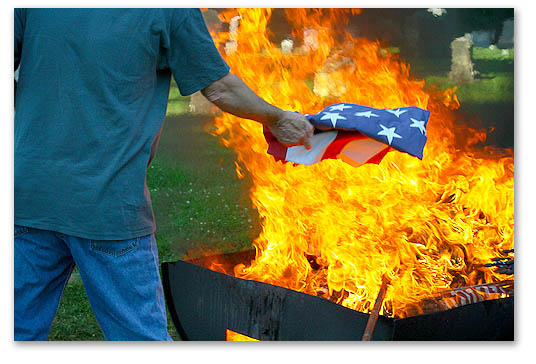
Hopefully, very soon, we will be able to change the retirement ceremony to a recycling method.
AFE Standards for When an American Flag Should Be Retired
On July 8, 2014, Mr. Redfield of Phoenix, Arizona, contacted American Flags Express regarding a tattered flag in his community. After researching, we found the only official guideline:
“When the flag is in such condition that it is no longer a fitting emblem of display it should be destroyed in a dignified manner.”
Clearly, additional guidelines are needed. After reviewing thousands of worn-out flags returned for recycling, we found that American flags typically wear out in three ways:
- Fading from UV exposure and precipitation
- Tearing or fraying beginning on the upper fly corner
- Grime buildup from pollutants, dust, and dirt
Our goal was to develop guidelines that apply to all flag sizes. After extensive review, we created the following standards:
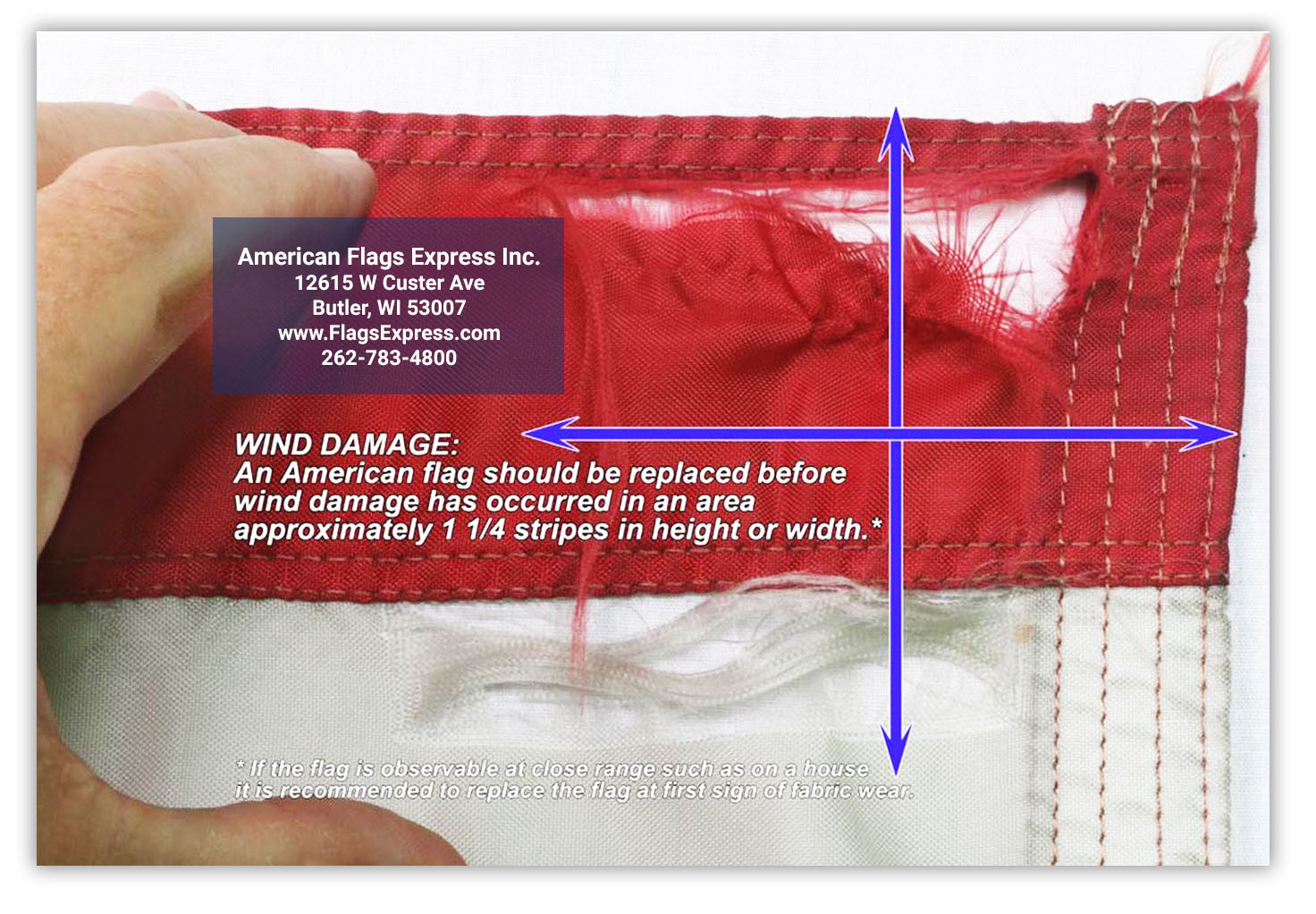
FRAYING: Retire a flag before fraying exceeds 1.25× the height of the top red stripe.
FADING: Retire a flag before the red or blue colors fade more than 20%.
Military bases, public buildings, and corporate facilities may choose to retire flags more often. Once fraying begins, damage worsens quickly, so early replacement is ideal.
Repairing Flags
Rather than replacing your flag, you can often have it repaired at a surprisingly low cost. Take it down at the first sign of a tear to ensure enough fabric remains to repair.
If you are unsure whether your flag is repairable, email a photo to KT@FlagsExpress.com and we will reply within 24 hours.
Pricing
• Most advantageous on 6'x10' and larger.
• Smaller flags should be retired unless they have sentimental value.
• Flags 6×10 and larger: cost = length × 2 (example: 10 ft → $20)
• Quotes may vary if the header needs repair or additional fabric is needed.
• Customer pays shipping.
• Visit our American flag repair page for detailed pricing.
Send repairs to:
FLAG FOR REPAIR
American Flags Express
12615 W Custer Ave
Butler, WI 53007
Tip: Many customers use a two-flag rotation — fly one flag while the other is being repaired.
What to do with historic or sentimental flags:
When a flag is of historic or sentimental value, it is recommended to get it restored. American Flags Express does quality restorations for museums, military entities, government agencies, heritage organizations and more! Email photos of your damaged flag for a repair estimate to Karen@FlagsExpress.com or call us today at 262-783-4800 x 14 .
Selecting the Correct Flag
Not sure which flag is right for your location or conditions? We are happy to help!
Call us at (262) 783-4800 x14 (Mon–Fri 9 AM–5:30 PM CST), or email Help@FlagsExpress.com.
Cleaning Flags
Washing your flag in warm detergent water occasionally will prevent pollutants and dirt from weakening the fabric. Always dry your flag completely before storing it to prevent mildew or color transfer.
See our detailed guide: Flag Washing & Maintenance
Patriot Guard Displays
Patriot Guard riders subject their flags to the toughest conditions.
A Patriot Guard member recently shared three important insights for extending flag life on motorcycles. The key to longevity is reducing flag snap through smooth, laminar airflow.

Proper Care of an American Flag
Do I need to take my flag down when it rains?
Most modern flags (nylon and polyester) are all-weather flags and do not need to be taken down during rain.
When should I display the American flag?
It is proper to display the flag 365 days per year. Extra effort should be made on national observances such as Memorial Day, Independence Day, Veterans Day, Pearl Harbor Day, and others.
Can a flag be flown at night without a light?
Yes, if there is enough ambient light for the flag to be recognized from a reasonable distance.
Is it illegal to burn a flag?
Burning a flag in protest is protected by free speech laws. Burning a retired, unserviceable flag in a respectful ceremony is also proper.
Can a governor order flags to half-staff?
Yes. Governors may issue proclamations for various state or national memorial events.
Is it disrespectful to wash an American flag?
No — washing is proper. Most synthetic flags can be washed in a washing machine. Tide detergent is particularly effective. Learn more: Flag Washing & Maintenance .