


OʻAHU, HAWAIʻI · DECEMBER 7, 1941
Look for the little boat.
Smoke fills the sky over Pearl Harbor. Down at the waterline, sailors have brought a boat alongside a burning battleship. There is someone in the water they can still save.
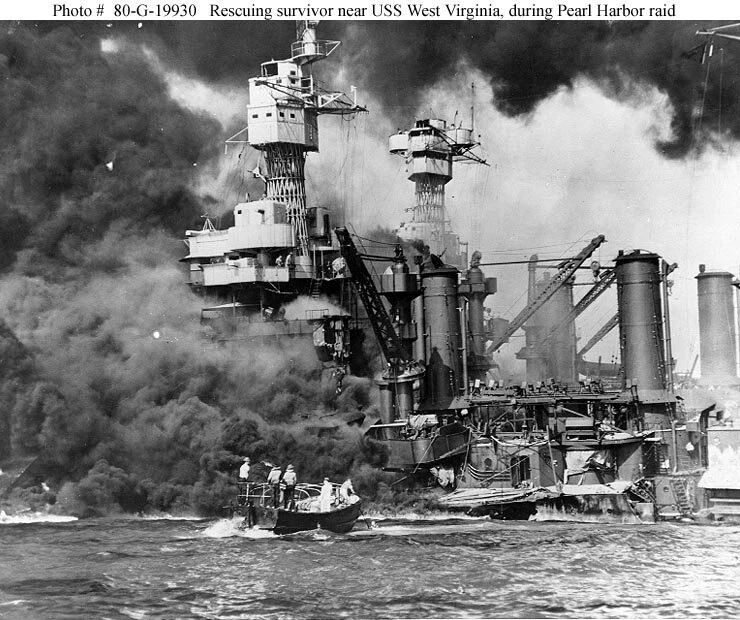
On Sunday, December 7, 1941, Japan attacked the U.S. Pacific Fleet at Pearl Harbor, on the Hawaiian island of Oʻahu. Here are seven facts about what Americans saw that morning, who survived, and what happened next.
-
Radar picked up the first wave at 7:02 a.m.
Two Army radar operators on Oʻahu saw an unusually large group of aircraft approaching from the north. They reported it. The officer who took the report knew American B-17 bombers were due from the mainland and thought the planes were friendly. The warning never reached the people about to come under attack.
-
The air attack lasted less than two hours.
Japanese aircraft struck Pearl Harbor at about 7:55 a.m. local time. Two waves hit ships in the harbor and airfields across Oʻahu. All eight U.S. battleships in the harbor were damaged or sunk. Across the island, 2,403 Americans died, including 68 civilians.
-
USS Arizona is the resting place of more than 900 men.
When USS Arizona sank, 1,177 members of its crew died. More than 900 of them remain aboard. Visitors to Pearl Harbor can stand above the battleship and see parts of it beneath the water.
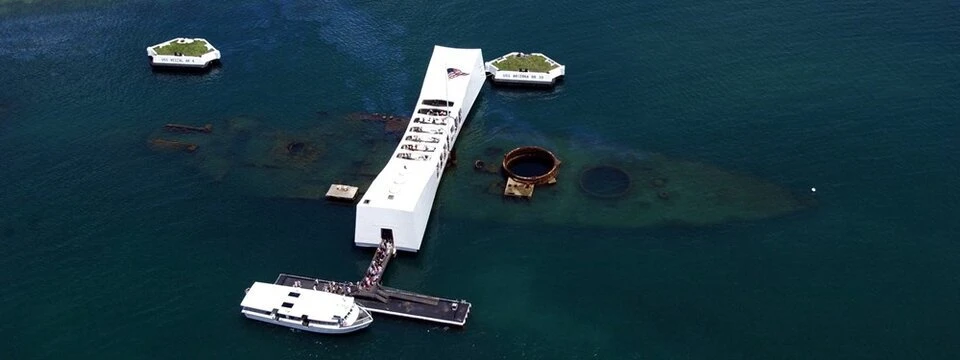
The white structure crosses the middle of the ship. In its shrine room, a marble wall bears the names of the men who died aboard. U.S. Navy photograph by Jayme Pastoric, via the National Park Service. -
All three Pacific Fleet aircraft carriers were away from Pearl Harbor.
USS Enterprise was returning from Wake Island. USS Lexington was on its way to deliver aircraft to Midway Island. USS Saratoga reached San Diego that morning. Six months later, the three American carriers at the Battle of Midway were Enterprise, Yorktown and Hornet.
-
Pearl Harbor’s shipyard could still repair ships.
The fleet’s fuel storage tanks and key repair facilities survived. In May 1942, the damaged carrier USS Yorktown came into Pearl Harbor. Shipyard workers had it ready to sail for Midway after just three days in dry dock. Some of the crew doing repairs went to sea with the ship to finish their work.
View photo of USS Yorktown arriving for repairs
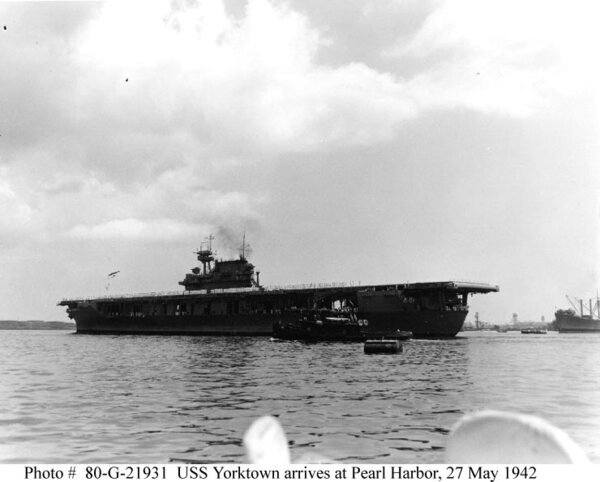
USS Yorktown enters Pearl Harbor on May 27, 1942, after the Battle of the Coral Sea. U.S. Navy / National Archives, 80-G-21931. -
Americans fought back. Japan lost 29 aircraft.
American pilots got planes into the air, and gunners fired from ships and shore. Aboard USS West Virginia, mess attendant Doris “Dorie” Miller helped wounded sailors and fired an antiaircraft gun he had never been trained to use. The Navy later awarded him the Navy Cross.
-
The United States declared war on Japan the next day.
On December 8, 1941, President Franklin D. Roosevelt asked Congress to declare war on Japan. The Senate voted 82–0. The House voted 388–1. Montana Representative Jeannette Rankin cast the lone vote against the declaration.
Historical sources
- 1–2. National Park Service, Timeline and The Pearl Harbor Attack. National Archives, Joint Address to Congress Leading to a Declaration of War Against Japan (1941).
- 2, 5–6. Naval History and Heritage Command, Pearl Harbor Attack.
- 3. National Park Service, USS Arizona Memorial.
- 4. Naval History and Heritage Command, Carrier Locations (December 7, 1941) and June 3 (1942 Midway entry).
- 5. Naval Sea Systems Command, Battle of Midway, account of the Yorktown repairs.
- 6. Naval History and Heritage Command, Miller (DE/FF-1091) and Cook Third Class Doris “Dorie” Miller.
- 7. U.S. Senate Historical Office, About Declarations of War by Congress. U.S. House of Representatives, History, Art & Archives, Rankin, Jeannette.