


July 20, 1969
The American Flag on the Moon
The story behind the ordinary nylon flag that became one of the most recognizable symbols in American history.
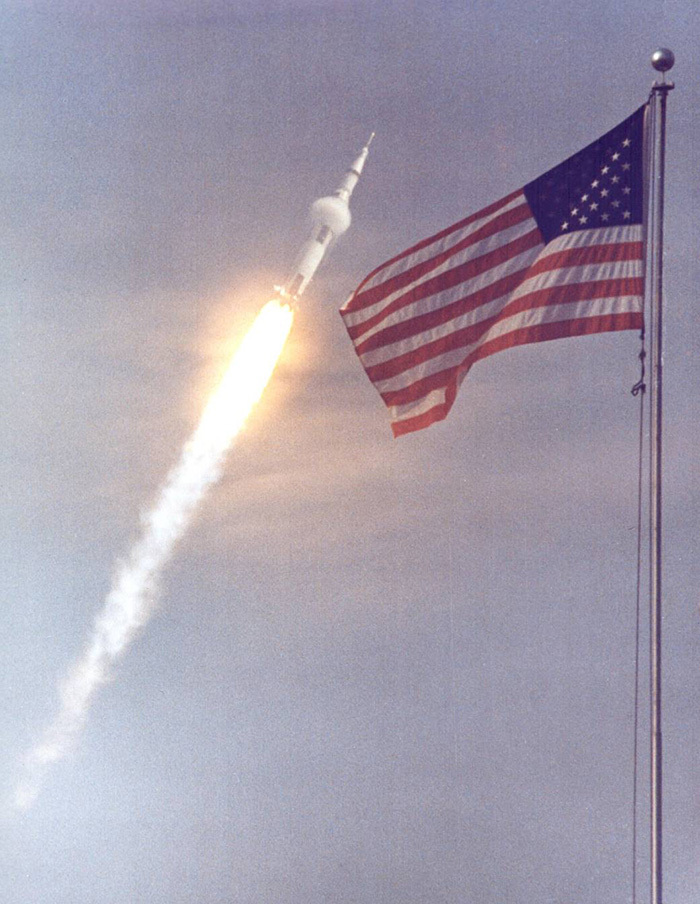
Apollo 11 launches from Kennedy Space Center on July 16, 1969.
On July 20, 1969, the American flag was planted on the Moon. Apollo 11 had launched from Kennedy Space Center four days earlier, carrying Neil Armstrong, Buzz Aldrin, and Michael Collins toward a goal that had seemed almost impossible less than a decade before. Armstrong and Aldrin landed the Lunar Module Eagle in the Sea of Tranquility, while Collins remained in orbit above them.
A few hours later, Armstrong stepped onto the lunar surface, followed by Aldrin. The moonwalk lasted only about two and a half hours, but the images from that night became permanent: two astronauts, a gray and silent landscape, the Lunar Module behind them, and the Stars and Stripes standing where no flag had ever stood before.
The flag was essentially a standard 3-by-5-foot nylon American flag, adapted for a place where there is no wind.
How Do You Fly a Flag Without Wind?
The flag itself was not some futuristic space-age banner. It was basically a standard nylon American flag, about 3 by 5 feet, adapted for a place with no wind. NASA’s engineers had to solve a simple but strange problem: on Earth, a flag flies because air moves through it. On the Moon, there is no atmosphere, so a normal flag would simply hang down.
The solution was the Lunar Flag Assembly, a lightweight system with a vertical staff and a horizontal support bar that held the flag open. That is why the Moon flag appears to wave in photographs. It was not moving in the wind. It was being held out by the structure built into the assembly.
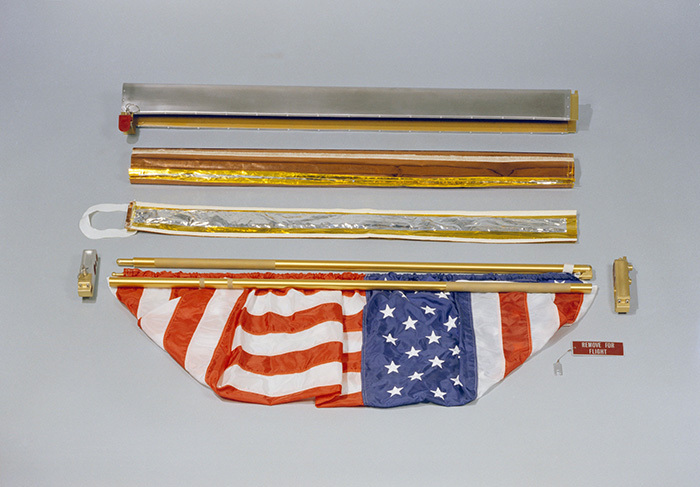
The complete Lunar Flag Assembly laid out before the mission, including the flag, aluminum staff, horizontal support bar, and protective case.
A Simple Design for a Difficult Job
The flag assembly was designed under the supervision of Jack Kinzler at NASA’s Manned Spacecraft Center in Houston. Kinzler, often described as one of NASA’s practical problem-solvers, developed the idea of using a horizontal rod through the top of the flag, similar to the way a curtain hangs from a rod.
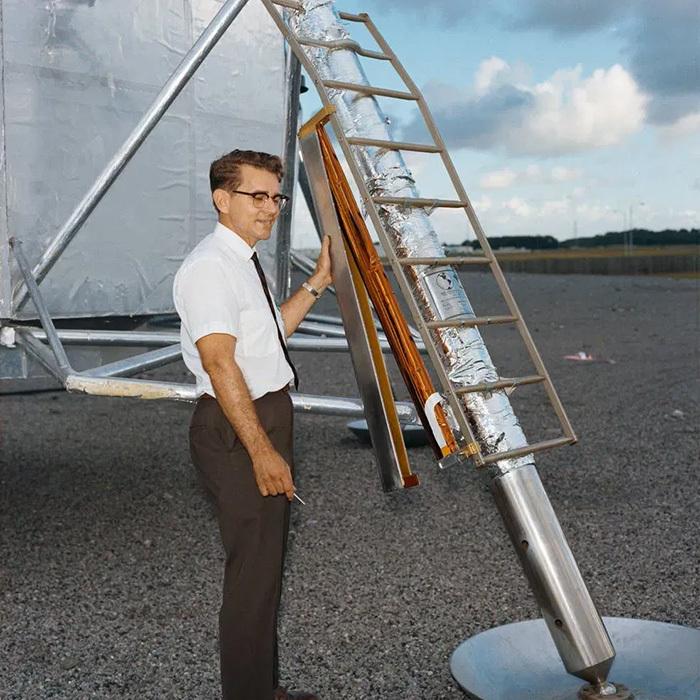
NASA engineer Jack Kinzler holds the packaged Lunar Flag Assembly beside Apollo 11 before the mission.
The pole and support pieces were made from lightweight aluminum tubing. The whole assembly had to be compact, light, and simple enough for astronauts to deploy while wearing pressurized suits and thick gloves. Even that was not easy. Armstrong and Aldrin struggled to drive the pole into the lunar surface and could only get it partway into the hard-packed soil.
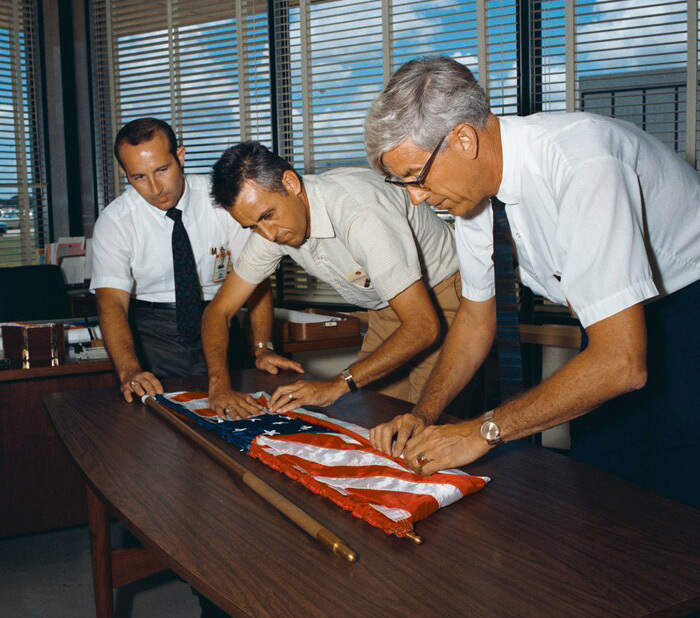
The flag and its support assembly had to be folded into a compact package for the journey to the Moon.
An Ordinary American Flag
There is some mystery around the exact origin of the Apollo 11 flag. NASA has noted that identifying labels and markings were removed before flight, so the specific manufacturer is not certain. It has often been reported that the flag was purchased through Sears and was, at its core, a normal nylon American flag.
That detail makes the story better, not smaller. The flag on the Moon was not a custom-built monument or an exotic piece of space hardware. It was an ordinary American flag, adapted with a special assembly so it could stand open in a place with no wind.
What happened to the Apollo 11 flag?
Buzz Aldrin later said he saw it knocked over by the Lunar Module’s exhaust when Eagle lifted off. Later Apollo crews planted their flags farther from their landers.
What the Moon Did to the Flags
The Moon was not kind to them. The flags left behind faced conditions no normal outdoor flag was made to survive: extreme heat and cold, unfiltered ultraviolet radiation, solar particles, and abrasive lunar dust. Over time, the colors of the nylon would almost certainly have faded badly. Some experts believe the surviving flags may now be bleached white or badly degraded.
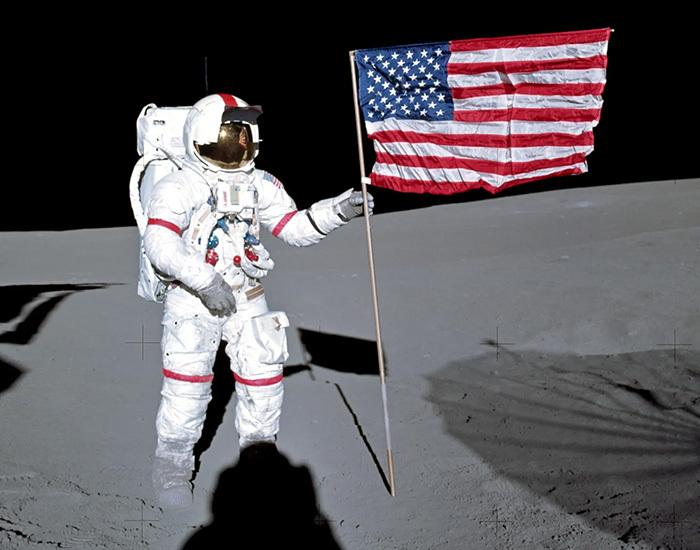
The horizontal support bar held the flag open in the Moon’s airless environment.
More Than a Piece of Fabric
That does not weaken the image. If anything, it makes it more human. The flag on the Moon was not a permanent monument built of stone or steel. It was fabric, tubing, planning, improvisation, and nerve.
It marked a moment when millions of people watched the same broadcast and saw the United States do something no nation had ever done. The flag did not claim the Moon as American territory. It stood as a symbol of the mission, the people who made it possible, and the country that had pushed itself across 240,000 miles of space to get there.
From the Moon to Our Test Lab
We’re Testing a Better American Flag
The Apollo flags were never designed to withstand years of unfiltered ultraviolet radiation. More than 50 years later, American Flags Express is working with product engineering and testing company CDN Inc. to learn exactly how UV exposure weakens and fades a flag—and how we can make one that lasts longer.
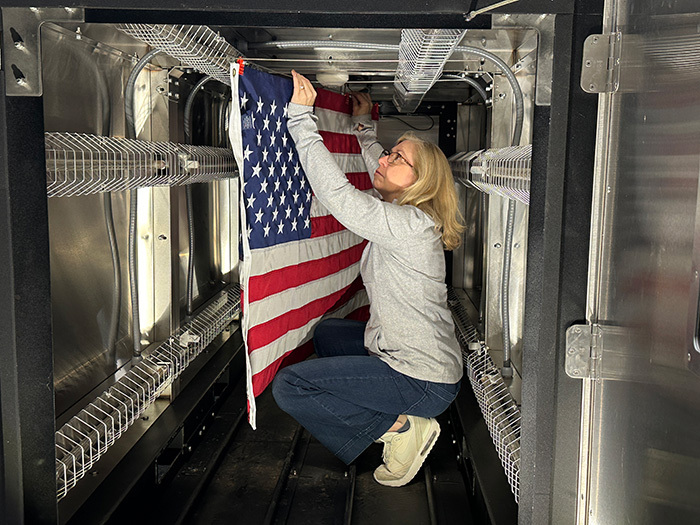
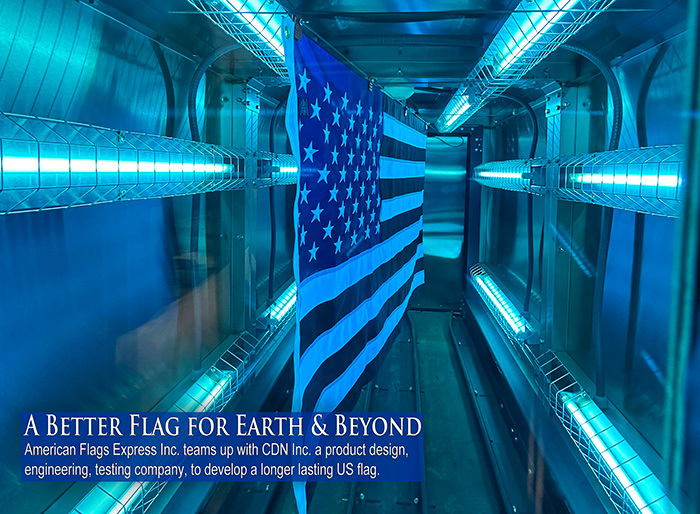
CDN built a specialized UV chamber that can simulate months of sunlight exposure in just six days. The results are helping us study fading, fiber weakening, construction methods, and the materials needed to build a more durable flag—whether it flies on Earth or someday travels to the Moon or Mars.
See How We’re Building a Better Flag →