


May 29, 1790: The Day the Original 13 Finally Became One Union
Rhode Island was the smallest state, but it raised one of the biggest questions of the founding era: how do you build a strong national government without giving it too much power?
Rhode Island’s Place in the Constitution Story
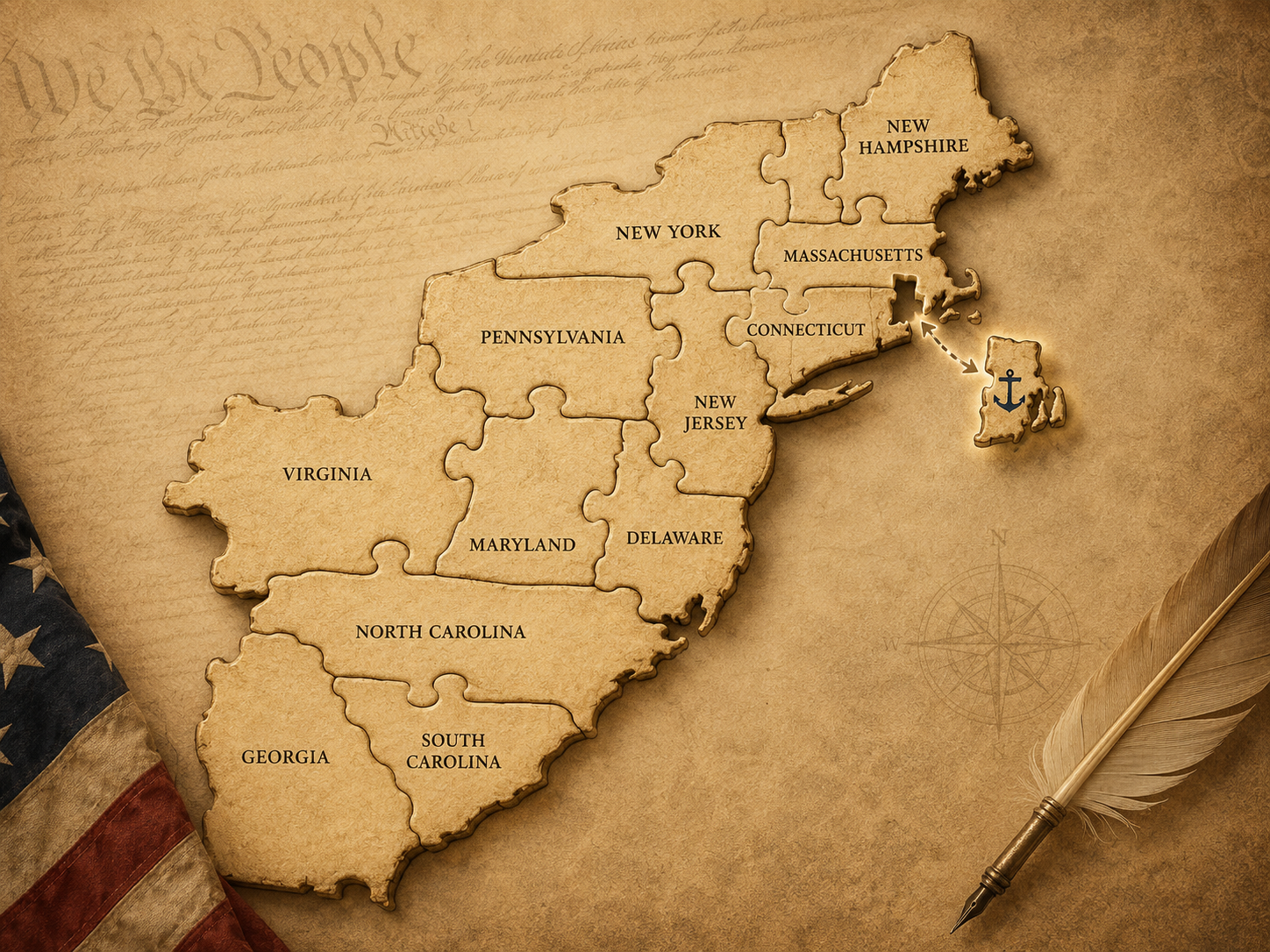
When Americans think about the Constitution, it is easy to imagine all 13 original states coming together at once. But Rhode Island’s story reminds us that the process was far more complicated.
By the time Rhode Island ratified the Constitution on May 29, 1790, George Washington was already president, Congress was already meeting, and the new federal government was already in motion.
Rhode Island’s narrow approval completed the original 13-state Union under the Constitution — and showed just how seriously Americans debated the balance between federal power, state authority, and individual rights.
How the Documents Fit Together
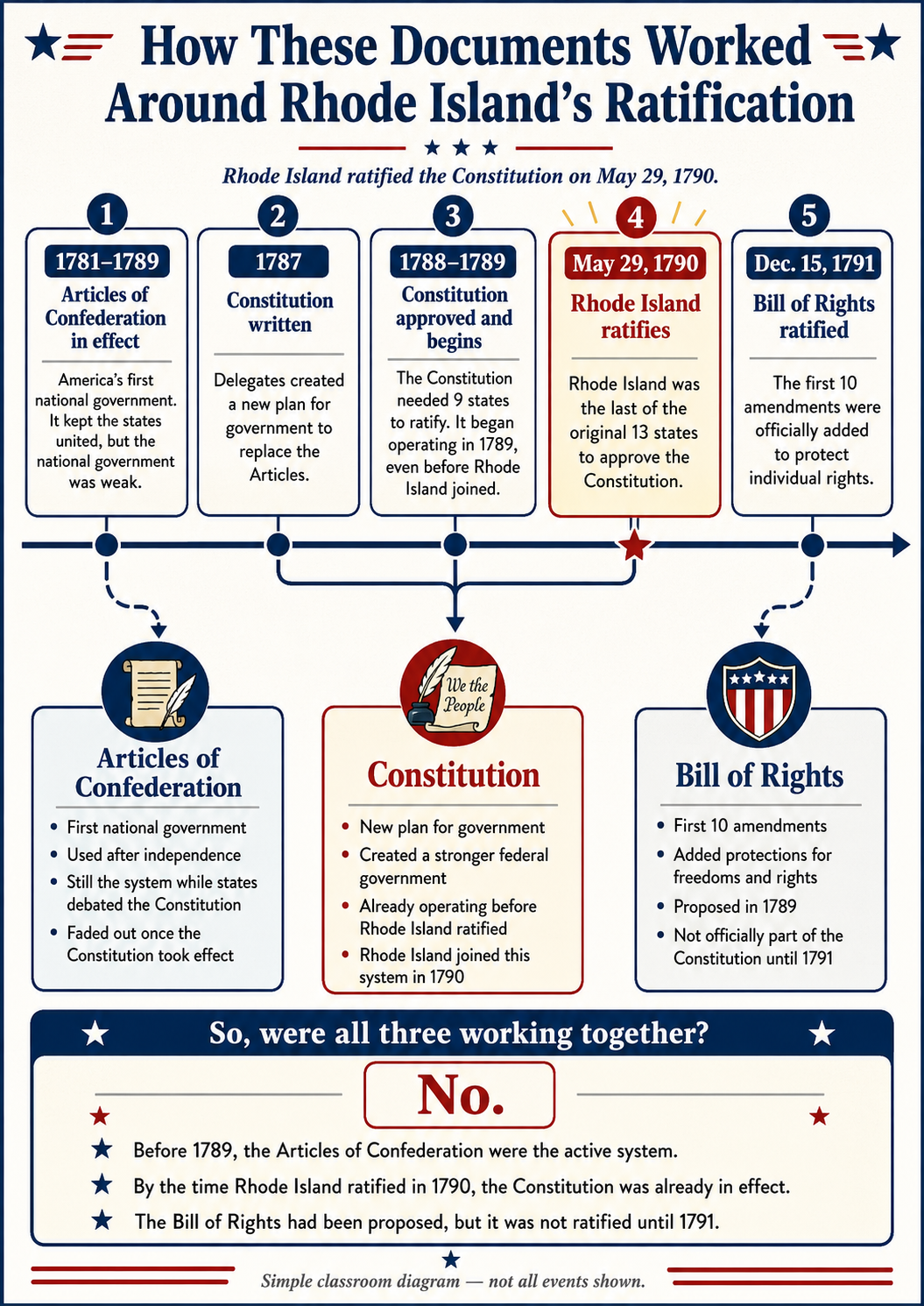
This simple timeline shows how the Articles of Confederation, the Constitution, and the Bill of Rights fit together around Rhode Island’s ratification.
The important point is that these documents were not all operating in the same way at the same time. The Articles of Confederation came first, the Constitution replaced them, and the Bill of Rights was added after Rhode Island ratified.
Quick Takeaway
- Rhode Island was the last of the original 13 states to ratify the Constitution.
- The Constitution was already in effect before Rhode Island joined.
- Rhode Island’s final vote was extremely close: 34 to 32.
- The Bill of Rights had been proposed, but it was not officially ratified until 1791.
7 Facts About Rhode Island Ratifying the Constitution
1 Rhode Island was the last of the original 13 states to ratify the Constitution.
Rhode Island finally approved the Constitution on May 29, 1790. That made it the last of the original 13 states to join the new constitutional system.
2 The Constitution was already in effect before Rhode Island joined.
The Constitution did not need all 13 states to approve it before the new government could begin. Article VII said approval from nine states was enough to establish the Constitution among the states that ratified it.
3 Rhode Island missed the Constitutional Convention entirely.
Rhode Island did not send delegates to the 1787 Constitutional Convention. That means it did not help write the Constitution, then resisted approving it afterward.
4 Rhode Island feared the new federal government would be too powerful.
Many Rhode Islanders wanted to protect state control, local trade, and their own economic policies. They worried that a stronger federal government could take too much authority away from the states.
5 The final vote was extremely close.
Rhode Island ratified the Constitution by a vote of 34 to 32. That means the last original state joined the Constitution by only two votes.
6 Rhode Island was under serious pressure to join.
By 1790, the new U.S. government was already running without Rhode Island. Congress had even moved toward restricting trade with Rhode Island, which would have made it difficult for the small coastal state to remain outside the Union.
7 Rhode Island joined before the Bill of Rights was officially ratified.
The Bill of Rights had already been proposed by Congress in 1789, but it was not officially ratified until December 15, 1791. So when Rhode Island joined in 1790, the Constitution was active, but the Bill of Rights was still in progress.
What the Constitution Changed
The Constitution created a stronger national government than the Articles of Confederation had provided. It established the three branches of government and created a system of checks and balances to help prevent any one branch from gaining too much power.
Rhode Island’s ratification did not begin the new government — that had already happened. But it did bring the last of the original 13 states into the constitutional Union.
Key Terms
Ratify
To officially approve something. In this case, states had to ratify, or approve, the Constitution before it could become the new plan for government.
Articles of Confederation
America’s first national government after the Revolutionary War. It kept the states loosely connected, but the national government was too weak to solve many problems.
Bill of Rights
The first 10 amendments to the Constitution. These protect important freedoms, including speech, religion, press, and the right to a fair trial.
Constitution
The plan for the United States government. It created the three branches of government, gave the national government more power, and included checks and balances to help prevent abuse of power.
Rhode Island’s ratification completed the original 13-state Union under the Constitution. Its story reminds us that the Constitution was not accepted without debate — and that questions about federal power, state authority, and individual rights were central from the very beginning.