


The POW/MIA flag first flew over the White House in 1982—but its story began with a military wife asking the country not to forget.
On August 10, 1990, Congress formally recognized the black-and-white POW/MIA flag as a national symbol of concern and commitment to accounting for Americans still missing or unaccounted for.
By then, the flag had already been displayed across the country for nearly two decades. Its story did not begin with Congress or a government agency. It began with military families searching for answers.
NATIONAL POW/MIA RECOGNITION DAY
Observed Annually on the Third Friday in September

A Military Wife Asked for a Symbol
In 1970, Navy Lt. Cmdr. Michael George Hoff was listed as missing in action after his aircraft failed to return to the USS Coral Sea.
His wife, Mary Hoff, was an active member of the National League of POW/MIA Families. At the time, families of captured and missing Americans were fighting to keep their loved ones before the public.
Mary believed they needed a recognizable symbol—something that could be displayed across the country and understood at a glance.
The POW/MIA flag did not begin in Washington. It began with a family looking for answers.
Mary’s request reached Norman Rivkees, an executive at a U.S. flag manufacturer. Rivkees worked with commercial artist and World War II veteran Newt Heisley to develop the design.
Designing the POW/MIA Flag
Heisley was a former Army Air Forces pilot who had served during World War II.
His design was deliberately stark: a bowed silhouette before a guard tower and strand of barbed wire, rendered entirely in black and white.
One widely repeated account says the gaunt silhouette was inspired by Heisley’s son Jeffrey, a young Marine who had returned home ill after training.
Above the image, the letters “POW” and “MIA” are divided by a white star. Beneath it is the message that came to define the flag:
YOU ARE NOT FORGOTTEN
The National League’s board approved the design in January 1972. No trademark or copyright was sought because the families wanted the emblem reproduced and displayed as widely as possible.
The POW/MIA logo remains in the public domain.
From a Family Movement to a National Symbol
1970: Mary Hoff begins seeking a symbol for America’s POWs and missing service members.
1972: The National League of POW/MIA Families approves the flag.
1979: The first national POW/MIA commemoration is held.
1982: The flag flies over the White House for the first time.
1986: The third Friday in September becomes the permanent annual observance.
1990: Congress formally recognizes the flag as a national symbol.
2019: Federal law expands its display at designated properties to every day the U.S. flag is flown.
In September 1982, the flag was flown over the White House, bringing the families’ symbol to one of the nation’s most visible settings.
On March 9, 1989, a League flag that had flown at the White House during the previous year’s observance was installed in the U.S. Capitol Rotunda.
On August 10, 1990, Congress passed Public Law 101-355, formally recognizing the POW/MIA flag as a symbol of the nation’s determination to account for missing Americans and provide answers to their families.
A 1998 law required its display on six annual observances at designated federal properties. The National POW/MIA Flag Act of 2019 expanded that requirement.
At specified locations—including the White House, U.S. Capitol, national cemeteries, major military installations, veterans memorials, VA medical centers and U.S. post offices—the POW/MIA flag must now be displayed every day the American flag is displayed.
How National POW/MIA Recognition Day Began
The first national commemoration was held on July 18, 1979. Congressional resolutions supported the observance, and a national ceremony took place at Washington National Cathedral. A Missing Man Formation was flown overhead.
The date changed several times during the following years.
To create an observance that was not associated with one particular war, the National League proposed the third Friday in September. That date was adopted in 1986 and has been used ever since.
Today, National POW/MIA Recognition Day is observed annually on the third Friday in September.
The observance honors Americans who endured captivity, those who remain missing or unaccounted for, and the families who have waited—sometimes for generations—for answers.
The Search Continues
The POW/MIA flag is not simply a memorial to a closed chapter of American history. The mission it represents remains active.
THE MISSION CONTINUES
Tens of thousands of Americans remain unaccounted for from past conflicts.
The Defense POW/MIA Accounting Agency continues searching for Americans missing from World War II, the Korean War, the Vietnam War and the Cold War.
Each year, the agency announces new identifications, returning names to service members who may have been missing for decades and providing long-awaited answers to their families.
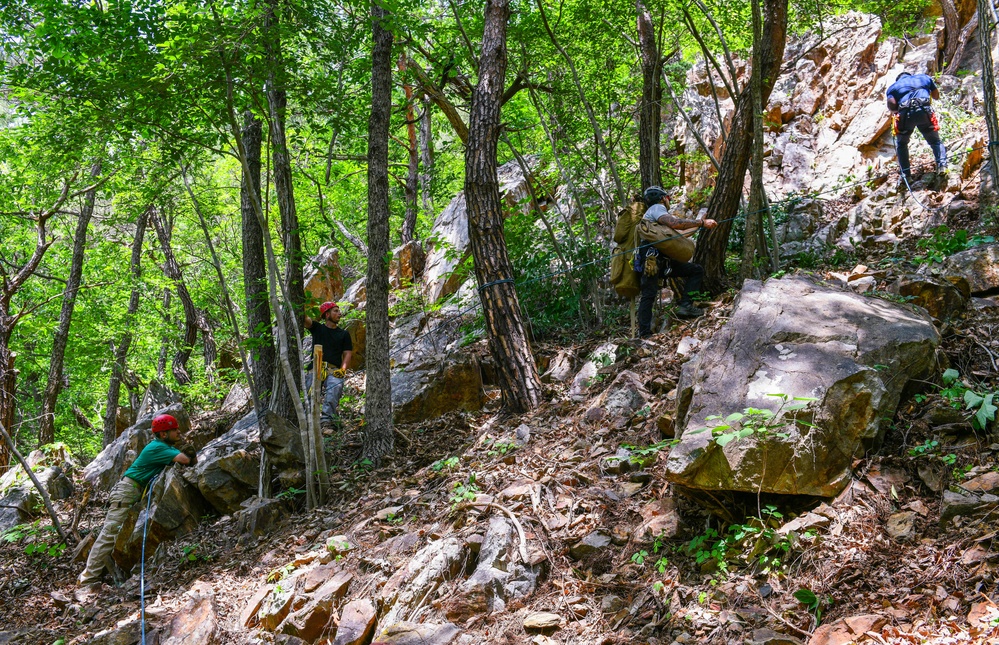
The work begins in archives and continues through witness interviews, field investigations, excavation and underwater recovery.
In laboratories, specialists use medical records, dental evidence, forensic anthropology and DNA to restore names to remains that may have been unidentified for decades.
How to Display the POW/MIA Flag
When displayed on the same staff, the POW/MIA flag should be placed directly below the United States flag.
It should be the same size as, or smaller than, the American flag—never larger.
When the flags are flown on separate staffs, the U.S. flag occupies the position of honor: its own right, which is the viewer’s left.
Recognition Day is not automatically a nationwide half-staff day. Follow any separate presidential or state order before lowering the American flag. Current orders appear on our half-staff alerts page.
A Promise in Four Words
The POW/MIA flag began with one family seeking answers. More than half a century later, it represents thousands of families and a national commitment extending across generations and conflicts.
Its black-and-white image is solemn because its subject is solemn. But its message is not one of surrender.
YOU ARE NOT FORGOTTEN
Those four words remain a promise to former prisoners of war, to the missing, to their families and to everyone still working to bring them home.
Made in America to Honor American Service
American Flags Express offers 100% made-in-the-USA outdoor POW/MIA flags in multiple sizes and materials, along with indoor, parade and double-sided options.
Displaying the flag at a home, business, school or veterans organization is one way to keep its message visible throughout the year.
Shop POW/MIA Flags Made in the USA
Sources: National League of POW/MIA Families, National POW/MIA Recognition Day history, Defense POW/MIA Accounting Agency, U.S. Senate Committee on Veterans’ Affairs and 36 U.S.C. § 902.
The appearance of U.S. Department of War visual information does not imply or constitute DoW endorsement.