


A Veterans Day History Exhibit · November 11

The Story Continues
History doesn't end in 1918.
Every veteran has a story worth hearing.
Continue to the stories ↓ Share a Veteran's StoryA Surprising Turn in the Calendar
All for a three-day weekend?
In 1968, Congress approved a plan to move several federal holidays to Mondays. The goal was simple: more three-day weekends for federal workers, with more time for travel and recreation. Veterans Day would move to October beginning in 1971.
It sounded convenient. But why did veterans, families, and so many states want November 11 back? To understand that, we have to return to the moment that started it all.
The Moment That Gave the Day Its Meaning
The 11th Hour · The 11th Day · The 11th Month
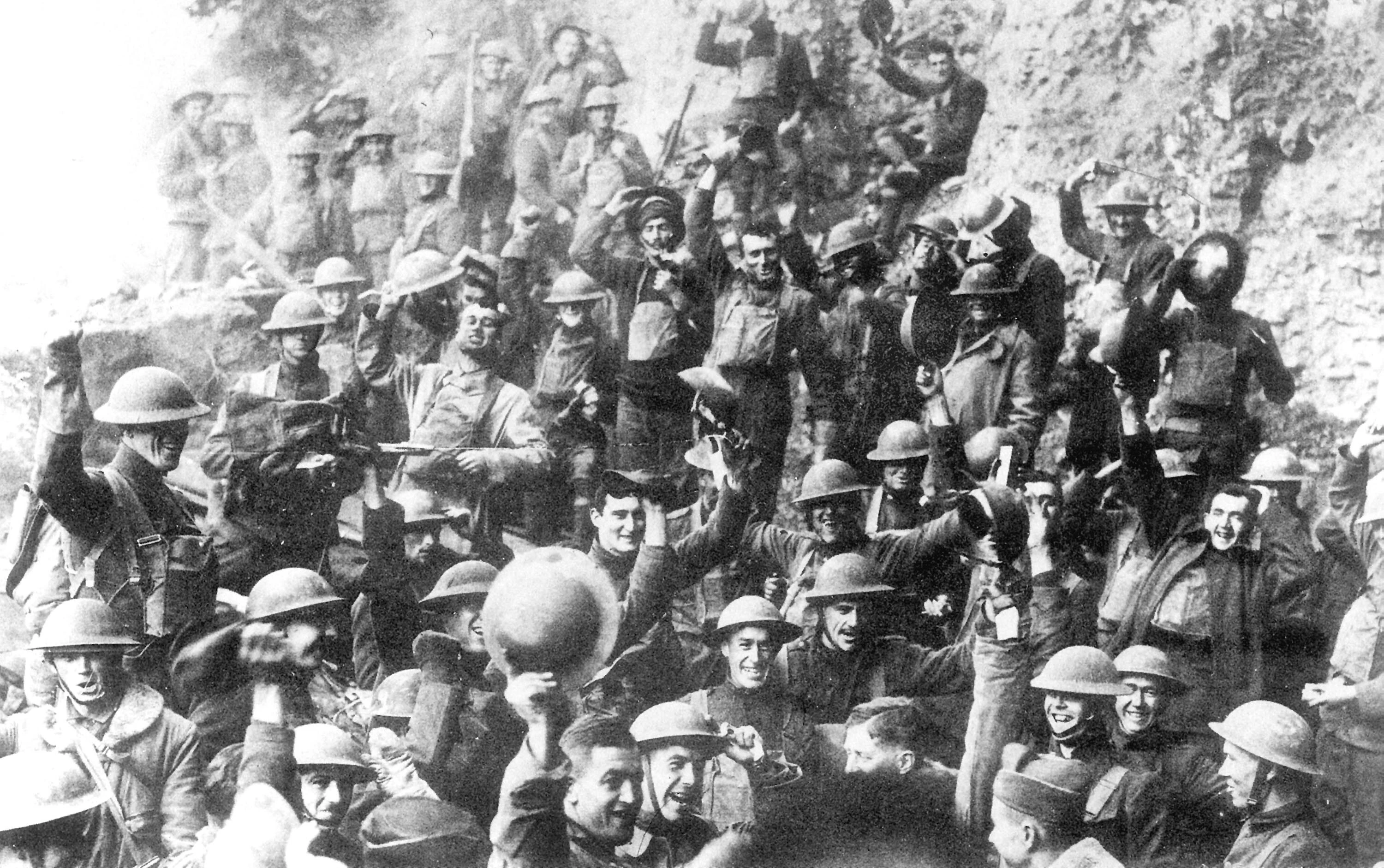
At 11 a.m. on November 11, 1918, the armistice took effect on WWI's Western Front. The gunfire stopped.
This moment would inspire Armistice Day, the original name of the holiday we now know as Veterans Day.
Why 11 a.m.? The agreement was reached shortly after 5 a.m., but the ceasefire was scheduled for 11 to give commanders time to carry orders along the front. That practical six-hour delay became one of history's most memorable moments.
Think of It Like This
Armistice = a formal ceasefire.
It stops the fighting. The final peace treaty can come later.
The Origins
How November 11 became a holiday
The guns fell silent
The Allies and Germany agreed to an armistice in 1918, ending fighting on the Western Front. The Treaty of Versailles followed in June 1919.
The date was no accident
The ceasefire took effect at 11 a.m. on November 11, 1918—why we still remember the eleventh hour, day, and month.
Armistice Day began in 1919
President Woodrow Wilson marked the first anniversary in 1919. The date became a federal holiday in 1938.
Its name grew with the nation
In 1954, after World War II and the Korean War, Congress changed Armistice Day to Veterans Day, recognizing veterans from more generations of service.
A century in just a few dates
Armistice takes effect
First commemoration
Federal holiday
Veterans Day named
The original 11 a.m. observance often included a brief pause in business, public gatherings, and parades. Read the VA timeline.

A Moment in the Record · 1954
A new name for generations of service
In 1954, President Dwight D. Eisenhower signed the law renaming Armistice Day as Veterans Day to recognize veterans across generations. The holiday was still observed on November 11. A different law, fourteen years later, would move its date.
The Calendar Detour
A holiday worth putting back
The 1954 law changed the name, not the date. Then Congress passed the Uniform Monday Holiday Act in 1968, moving Veterans Day's federal observance to the fourth Monday in October starting in 1971. The idea was more three-day weekends—but the change soon proved far less popular than expected.
The Monday Law
Congress passed the Uniform Monday Holiday Act, signed by President Lyndon B. Johnson. Four federal holidays, including Veterans Day, were set for Mondays to create more three-day weekends.
October Veterans Day
The first October observance fell on October 25. Some states kept honoring November 11, creating confusion over when Veterans Day should be observed.
The Correction
After opposition from veterans' organizations and many states, President Gerald Ford signed legislation returning the holiday to November 11, effective in 1978.
November 11 Returns
Veterans Day returned to November 11, reconnecting the holiday with the 1918 armistice and decades of observances.
Why move it in the first place?
Supporters hoped predictable long weekends would encourage family visits, travel, recreation, and commerce. On the calendar, it looked practical.
Why did the old date still matter?
Because November 11 wasn't an arbitrary date. Since 1919, people had gathered to remember the actual moment the guns fell silent. Even after other wars and new generations of veterans, that connection endured. Veterans' organizations objected, and by 1975, 46 states had either kept or returned to a November 11 observance.
Some dates carry a meaning worth remembering.
In Their Own Words
When the guns fell silent
One officer didn't describe a parade or a speech. He described a silence so unexpected that it changed what he could hear.
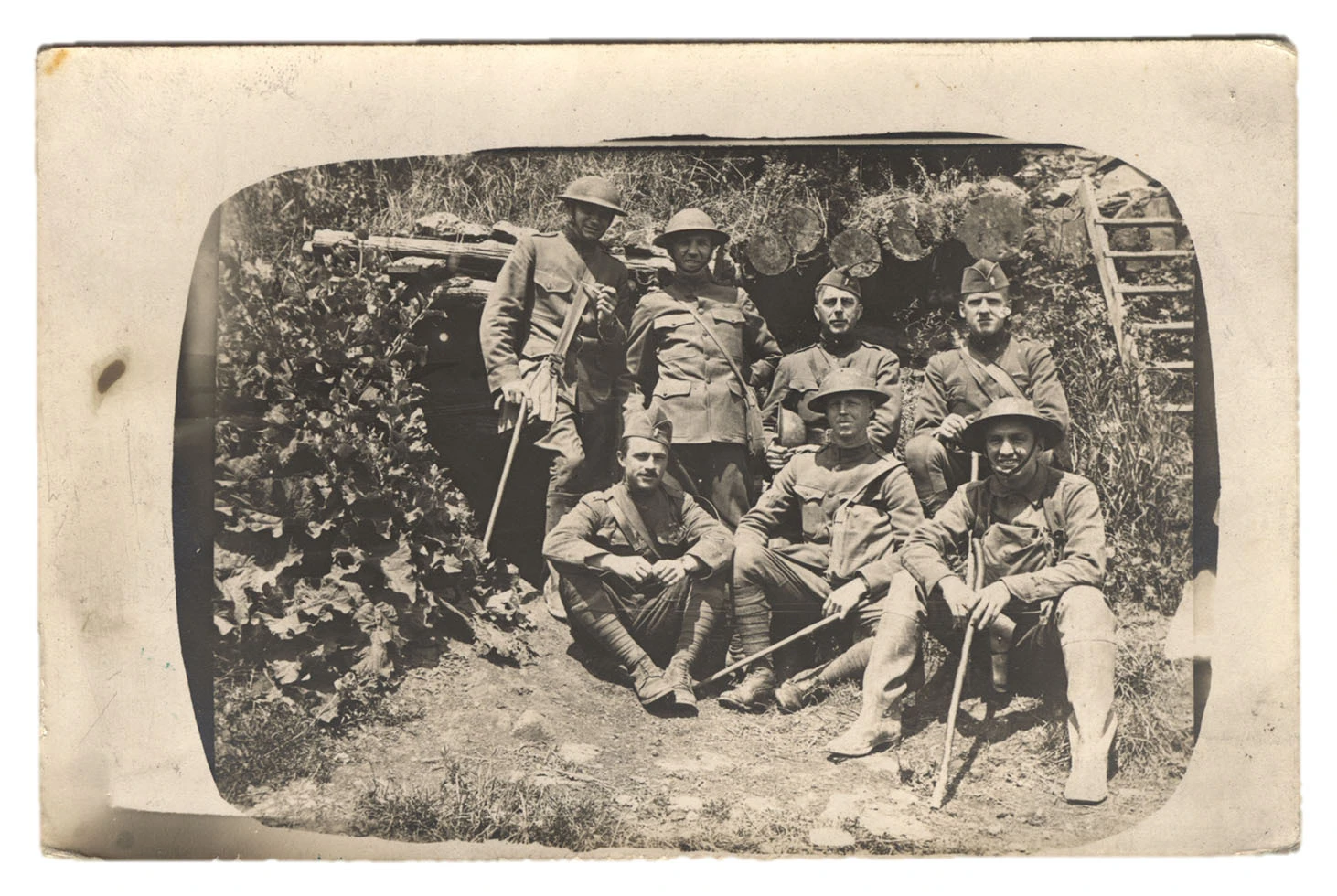
Stanhope Bayne-Jones with fellow soldiers, circa 1918. National Library of Medicine, Stanhope Bayne-Jones Papers, MS C 155, Box 9, Folder 12. Archival record. Select image to enlarge in a new tab.
A real letter. A real moment.
On November 11, 1918, U.S. Army medical officer Dr. Stanhope Bayne-Jones wrote to his sister Marian about the end of the fighting.

Select letter to enlarge in a new tab.
From the Archive
“The Armistice began at 11 o'clock this morning. We knew the time of the day by the sudden silence. Suddenly all the guns behind us stopped barking and rolling, the last 'Freight car' rattled over our heads, and all the machine guns suddenly stopped, though they had been rioting away up to the very last minute.”
After years of artillery and machine-gun fire, even the sound of water dripping nearby became noticeable. The quiet felt almost unbelievable.
“This silence, however, is getting on my nerves.”
Read the November 11, 1918 letter (select to open or close)
Adapted from the National Library of Medicine's published transcript of Dr. Stanhope Bayne-Jones's letter to his sister Marian. Paragraph presentation and apparent typographical errors have been adjusted for online reading. Some historical wording is marked [sic].
Historical language note: The letter uses “Boche” and “Boches,” derogatory terms for Germans used during World War I. We preserve the original language for historical accuracy, not as an endorsement of those terms.
Nov. 11, 1918.
Dear Marian:
The Armistice began at 11 o’clock this morning. We knew the time of the day by the sudden silence. Suddenly all the guns behind us stopped barking and rolling, the last “Freight car” rattled over our heads, and all the machine guns suddenly stopped, though they had been rioting away up to the very last minute. There was a cold dense mist, in which I suddenly noticed that I could hear water dripping off a bush next to me. Our guns stopped – and no shells were coming on us. It seemed mysterious, queer, unbelievable. All the men knew what the silence meant, but nobody shouted or threw his hat in the air. We asked ourselves a few questions, wondered if it were really all over – and then someone said “I guess I’ll go look for some grub.” Everybody up here has had so much work lately and seen so many things worse than peace, that even the cessation of hostilities was at first not exciting.
As the day wore on, and the silence become [sic] more permanent, the men began to cheer up. Tonight the front looks like a Fourth of July celebration. Our men and the Boches are shooting up all the flares and rockets in the dumps. You can see thousands of lights along the lines for miles – green stars, six red stars, “golden rain”, white flares, every sort of signal. I’ve seen the Boche call for a barrage and our rocket for a barrage go up in hundreds of places. Last night that would have meant a hail of shells and drumfire explosions for hours. It seems too good to be true.
From one corner of this hill I saw the strangest sight of the war, – a line of little fires indicating our front line, and, not far off, a line of fires in the Boche line – where the men were warming themselves, because it is quite cold. That would never have happened if the war were not over.
The next thing is – when will we get home? Soon I hope.
This morning I nearly got picked off 15 minutes before the shooting stopped. I was going down a ravine with some litter bearers to get a wounded man, when all of a sudden a machine gun ahead opened up and the bullets came clipping by, hit the ground and trees around us, and made us throw ourselves on our bellies in any old hole. You could see the bullets kick up the ground on the edge of the road. So we lay there until the armistice let us get up. It would have been tuck [sic] luck to get such a souvenir at that time.
We have been fighting in a sector east of the Meuse – north of Verdun – over the old Verdun battle field. I guess the censor won’t mind my telling you that I am near a ruin of a town called Flabas which we took two days ago.
Grub has been a serious matter. Because of the shelling and bad roads, we didn’t get much to eat for two days. Rations came up this afternoon and with it your letter of October 14. So I am set up tonight, enjoying your letter, having a good time writing to you, and going to bed and to sleep, knowing that I won’t be pulled out to see a wounded man, or have a gas alarm.
This silence, however, is getting on my nerves.
Love to all,
Stan
Original letter: Stanhope Bayne-Jones Papers, MS C 155, Box 7, Folder 21. Courtesy of the National Library of Medicine.
View the National Library of Medicine's archival reference .
Why We Observe
Two holidays. Two different traditions.
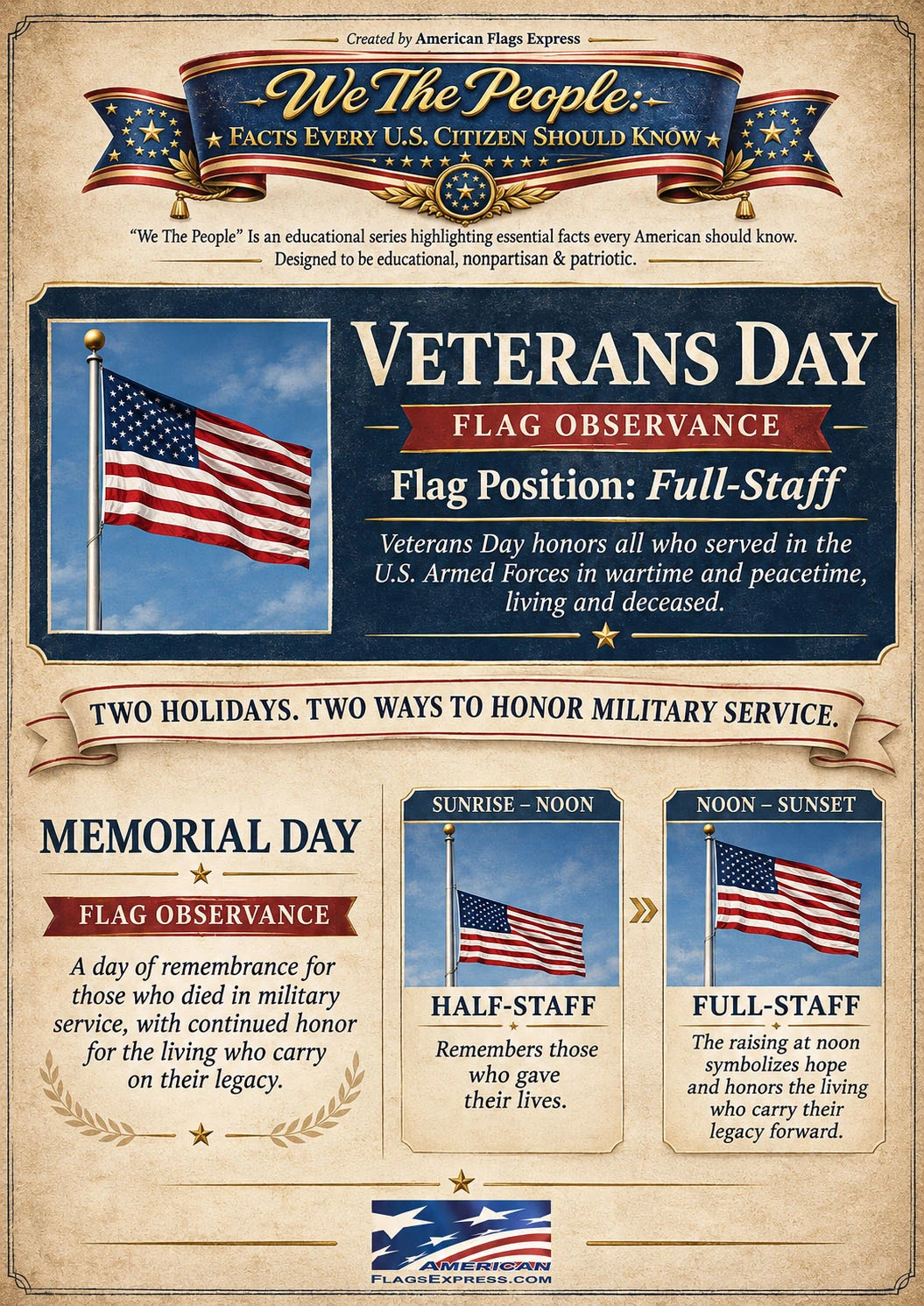
Flag honors guide · Select to enlarge in a new tab.
Service belongs to every generation
Veterans Day honors all who served in the U.S. armed forces, living or deceased, in wartime or peacetime. Their stories are not limited to a rank, battle, or period of service.
Memorial Day is different
Memorial Day honors those who died in military service. Veterans Day honors veterans, especially living veterans, and recognizes service across generations.
Are flags at half-staff on Veterans Day?
Veterans Day: The U.S. flag is normally flown at full-staff, unless a separate official half-staff order applies.
Memorial Day: The U.S. flag is flown at half-staff from sunrise until noon, then raised briskly to full-staff through sunset. The raising is often understood as a hopeful commitment by the living to carry service forward.
Service tells a story that continues long after a uniform is put away.
The Traditions Today
Remembrance, gratitude, and a name with meaning
Observed here and around the world
November 11 is also marked in many other countries, often as Armistice Day or Remembrance Day. At Arlington National Cemetery, a national Veterans Day ceremony includes tribute at the Tomb of the Unknown Soldier.
There is no apostrophe in Veterans Day
The holiday does not “belong” to one veteran or group; its name recognizes veterans as a whole. The official spelling is Veterans Day.
History Is Personal
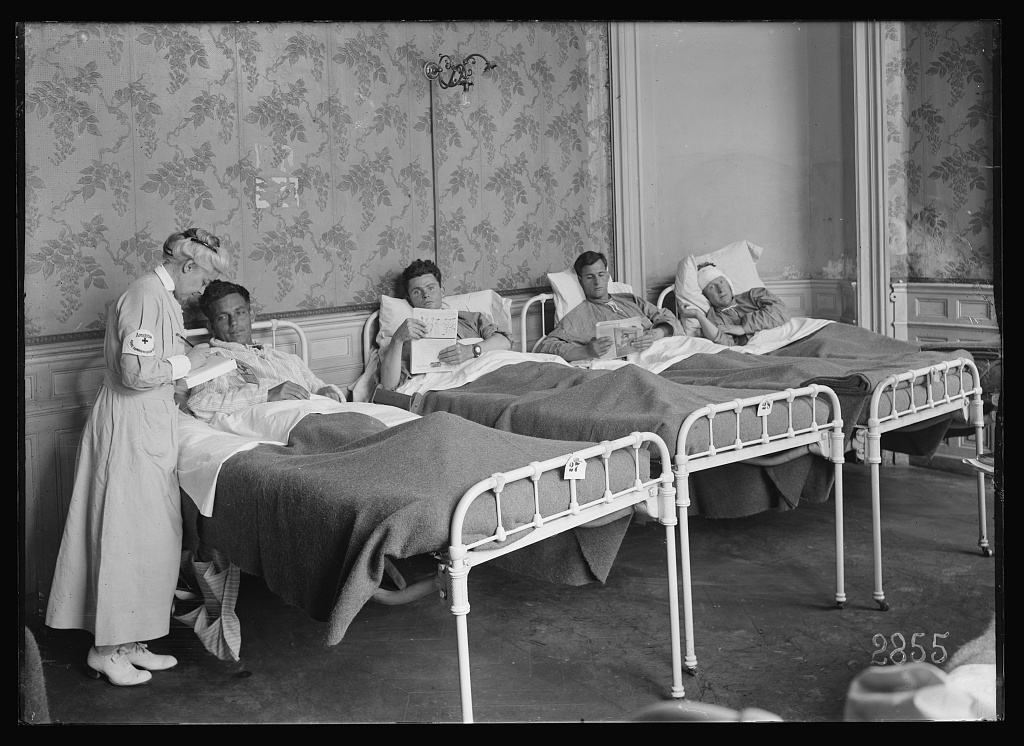
The stories don't stop in 1918.
Maybe it's a letter tucked into a drawer. A friendship that lasted for decades. Or the time someone made the whole platoon do push-ups because they couldn't make their bed.
Those are the stories we want to hear—funny, ordinary, remarkable, or deeply personal. No military résumé needed.
Share a Veteran's Story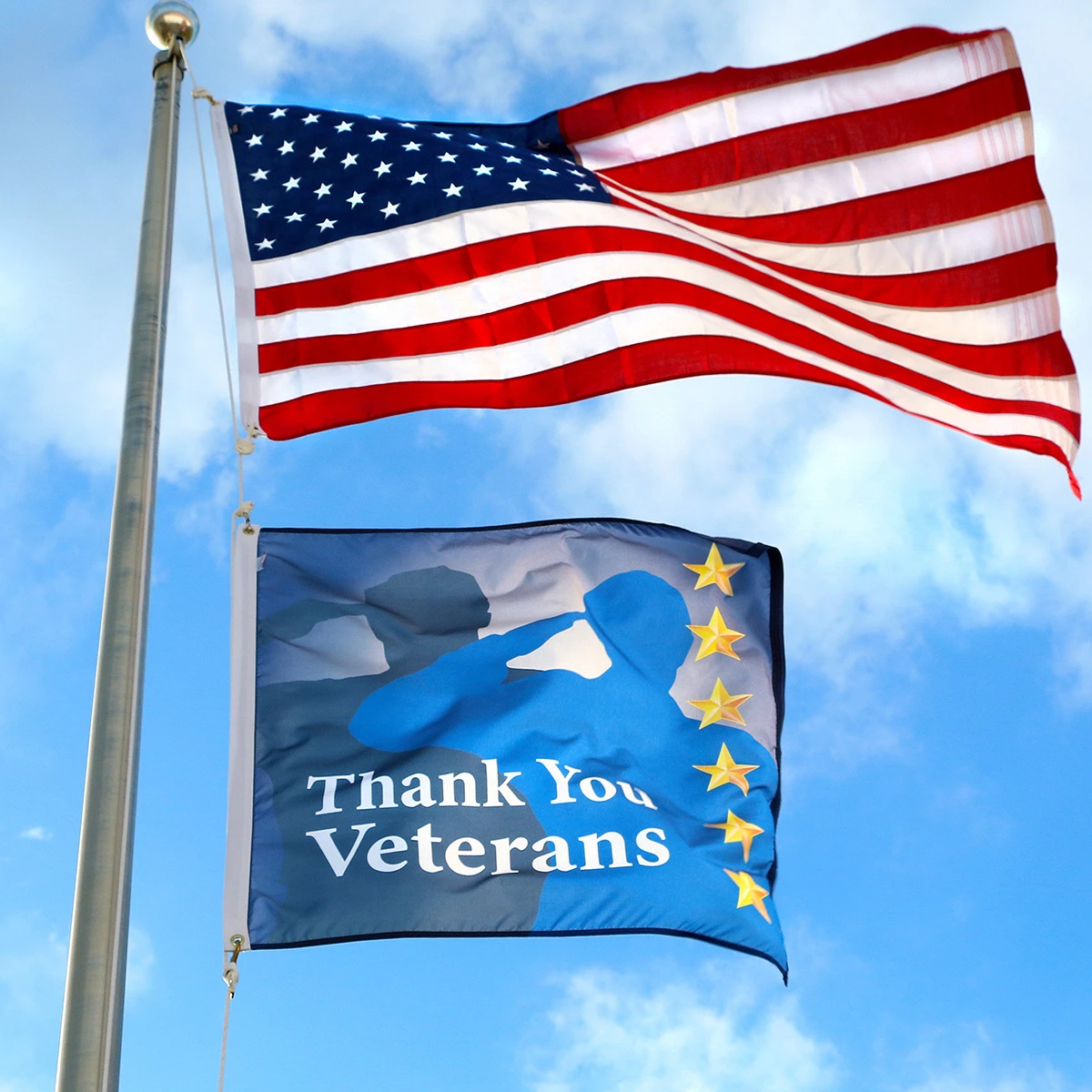
A Flag That Gives Back
Thank You Veterans
Through sales of our Thank You Veterans Flag, American Flags Express contributes to an organization helping provide homes for veterans.
View the Thank You Veterans Flag