

THANKSGIVING · AN UNEXPECTED AMERICAN STORY
You know
her rhyme.
Meet the woman
behind it.
Sarah Josepha Hale published “Mary Had a Little Lamb.” She also spent years urging Americans to celebrate Thanksgiving on the same day.
In 1863, with the country at war with itself, she carried that campaign to Abraham Lincoln.
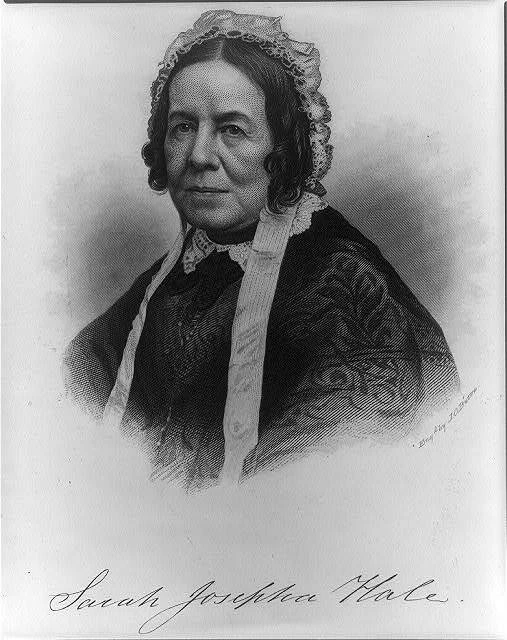
Engraving published in 1881, after her death. Library of Congress.
Her cause: a shared annual date. Thanksgiving existed before Hale. She helped shape the national tradition we recognize today.
01 / THE WORDS YOU REMEMBER
A little lamb.
A much bigger legacy.
“Mary had a little lamb,
Its fleece was white as snow”
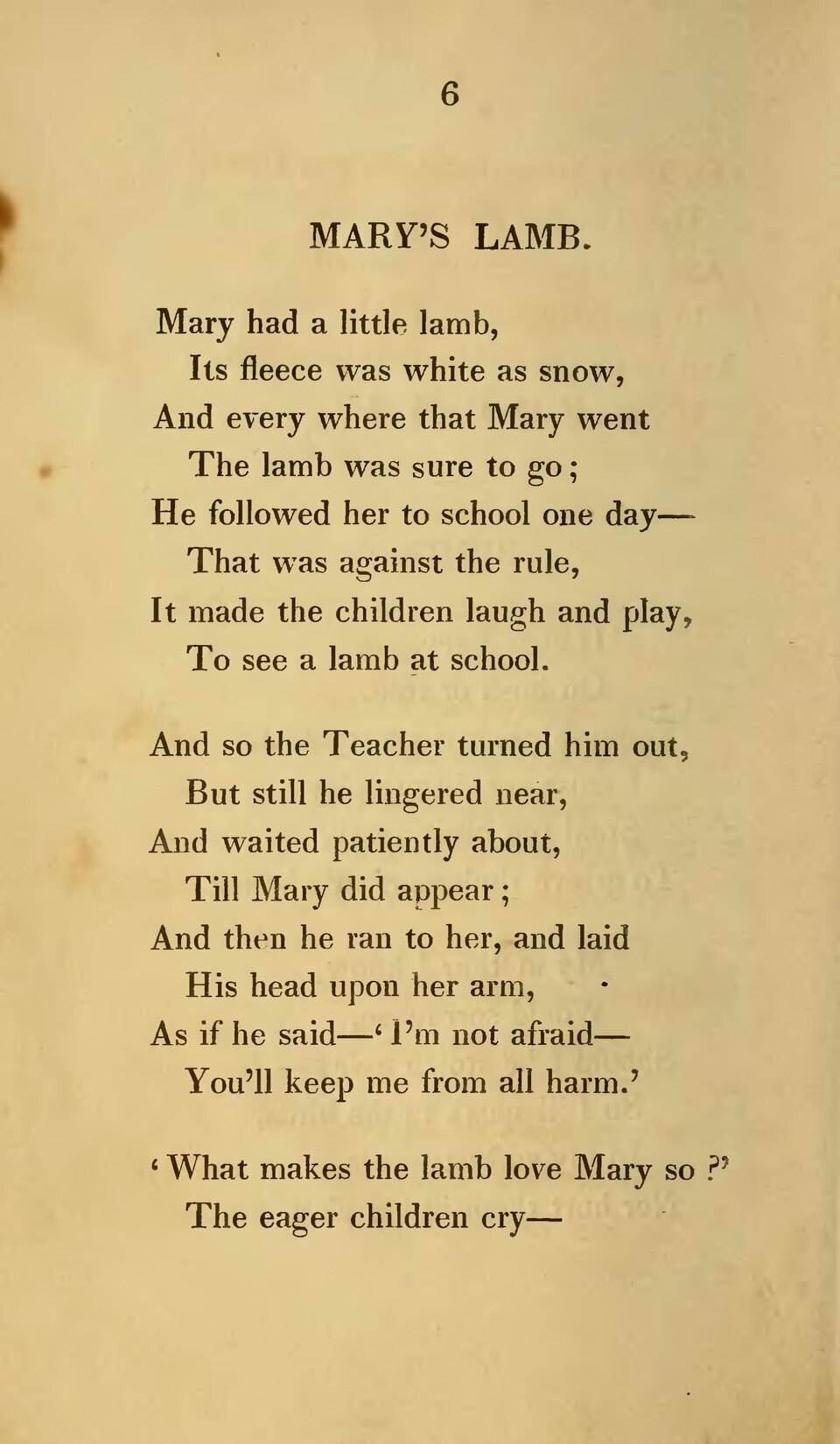
The familiar opening appears on this page from Hale’s 1830 book. The poem’s title was simply “Mary’s Lamb.”
The woman behind those verses also edited one of America’s influential magazines. That gave her something a national campaign needed: a way into people’s homes.
More about Sarah’s lifeClick or tap this bar to open or close
Hale was born in New Hampshire in 1788 and educated at home. After her husband died in 1822, she supported five children and built a career as a writer and editor.
She championed women’s education and paid women for their writing. In 1840, she helped lead a fundraising fair that brought in more than $30,000 for the Bunker Hill Monument.
Her views also had limits: she opposed women’s suffrage, the right to vote. Her support for education did not extend to political equality.
She retired from editing in 1877, at age 89. She died in 1879.
02 / THE PAGES THAT CARRIED A CAMPAIGN
A magazine became her megaphone.
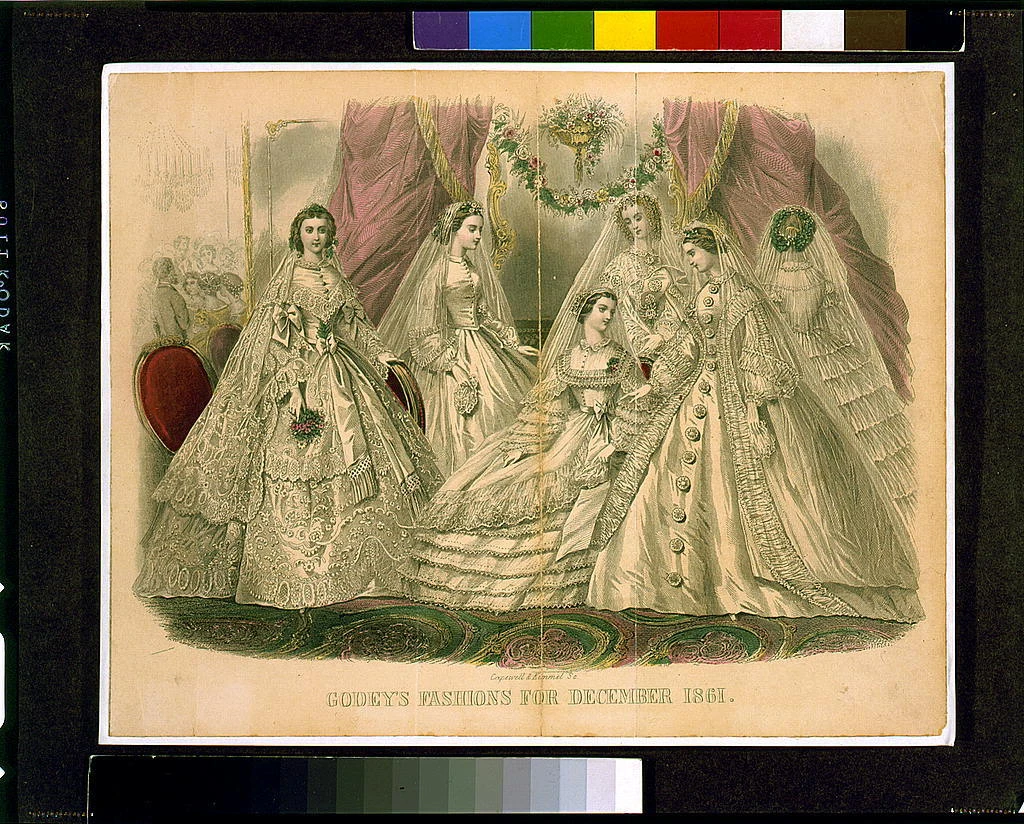
Godey’s Lady’s Book carried fashions, fiction and household advice. In her editorial pages, Hale returned again and again to the idea of a shared Thanksgiving.
She imagined Americans gathering on the same day, wherever they lived. In an October 1857 editorial, she hoped there would be:
“nor a seat left vacant at the Table of the Nation.”
03 / PERSISTENCE, THEN A TURNING POINT
15 years
of advocacy in her magazine, according to Hale’s own letter.
5 days
between the date on her letter and Lincoln’s proclamation.
September 28, 1863
Hale writes to Lincoln.
October 3, 1863
Lincoln issues the Thanksgiving proclamation.
One letter did not do all the work. These dates mark a turning point in a campaign that had already gathered years of support.
04 / INSIDE THE LETTER
Five words.
A national ambition.
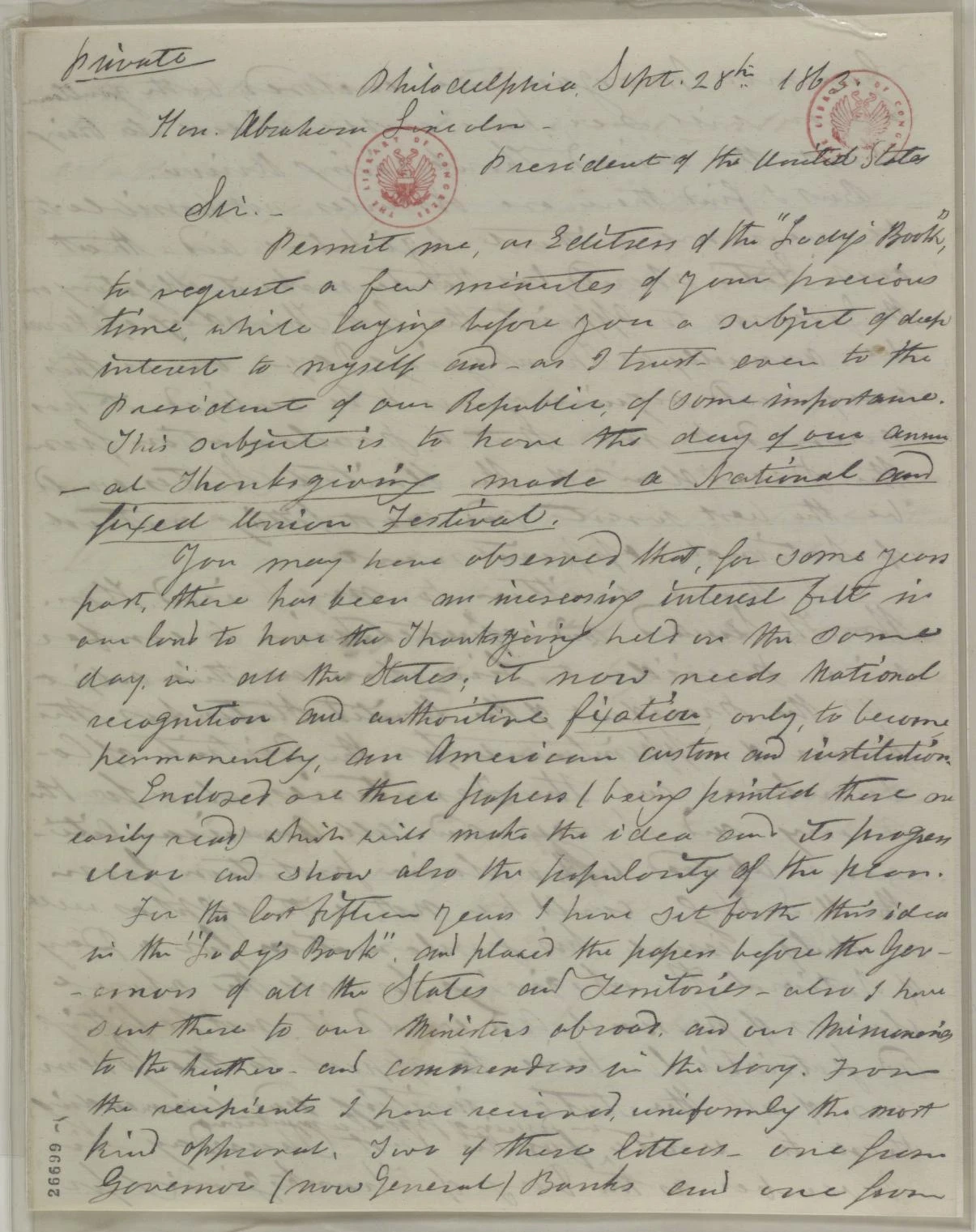
“National and fixed
Union Festival.”
Hale wanted a date Americans could share every year. She asked Lincoln to make a national announcement and invite the governors to join.
She had already contacted Secretary of State William H. Seward. Now she pressed for a prompt proclamation so states would have time to act.
Her practical plan:
Choose one date.
Ask the states to join.
Announce it in time.
Read Hale’s full letterClick or tap this bar to open or close
September 28, 1863. Historical wording and spelling follow the Library of Congress transcription; line breaks have been simplified.
Private
Philadelphia, Sept. 28th 1863.
Sir.--
Permit me, as Editress of the "Lady's Book", to request a few minutes of your precious time, while laying before you a subject of deep interest to myself and -- as I trust -- even to the President of our Republic, of some importance. This subject is to have the day of our annual Thanksgiving made a National and fixed Union Festival.
You may have observed that, for some years past, there has been an increasing interest felt in our land to have the Thanksgiving held on the same day, in all the States; it now needs National recognition and authoritive fixation, only, to become permanently, an American custom and institution.
Enclosed are three papers (being printed these are easily read) which will make the idea and its progress clear and show also the popularity of the plan.
For the last fifteen years I have set forth this idea in the "Lady's Book", and placed the papers before the Governors of all the States and Territories -- also I have sent these to our Ministers abroad, and our Missionaries to the heathen -- and commanders in the Navy. From the recipients I have received, uniformly the most kind approval. Two of these letters, one from Governor (now General) Banks and one from Governor Morgan are enclosed; both gentlemen as you will see, have nobly aided to bring about the desired Thanksgiving Union.
But I find there are obstacles not possible to be overcome without legislative aid -- that each State should, by statute, make it obligatory on the Governor to appoint the last Thursday of November, annually, as Thanksgiving Day; -- or, as this way would require years to be realized, it has ocurred to me that a proclamation from the President of the United States would be the best, surest and most fitting method of National appointment.
I have written to my friend, Hon. Wm. H. Seward, and requested him to confer with President Lincoln on this subject As the President of the United States has the power of appointments for the District of Columbia and the Territories; also for the Army and Navy and all American citizens abroad who claim protection from the U. S. Flag -- could he not, with right as well as duty, issue his proclamation for a Day of National Thanksgiving for all the above classes of persons? And would it not be fitting and patriotic for him to appeal to the Governors of all the States, inviting and commending these to unite in issuing proclamations for the last Thursday in November as the Day of Thanksgiving for the people of each State? Thus the great Union Festival of America would be established.
Now the purpose of this letter is to entreat President Lincoln to put forth his Proclamation, appointing the last Thursday in November (which falls this year on the 26th) as the National Thanksgiving for all those classes of people who are under the National Government particularly, and commending this Union Thanksgiving to each State Executive: thus, by the noble example and action of the President of the United States, the permanency and unity of our Great American Festival of Thanksgiving would be forever secured.
An immediate proclamation would be necessary, so as to reach all the States in season for State appointments, also to anticipate the early appointments by Governors.
Excuse the liberty I have taken
With profound respect
Yrs truly
Sarah Josepha Hale,
Editress of the "Ladys Book"
Transcription: Lincoln Studies Center, Knox College, for the Library of Congress.
05 / THANKSGIVING IN A DIVIDED COUNTRY
Gratitude.
Grief.
Hope.
Lincoln called for Thanksgiving on November 26, 1863. His proclamation gave thanks to God while remembering the war’s widows, orphans and mourners. It asked for the nation’s wounds to heal.
The Civil War was still being fought. Confederate states did not accept Lincoln’s authority. The common observance expressed a hope for unity; it did not produce unity overnight.
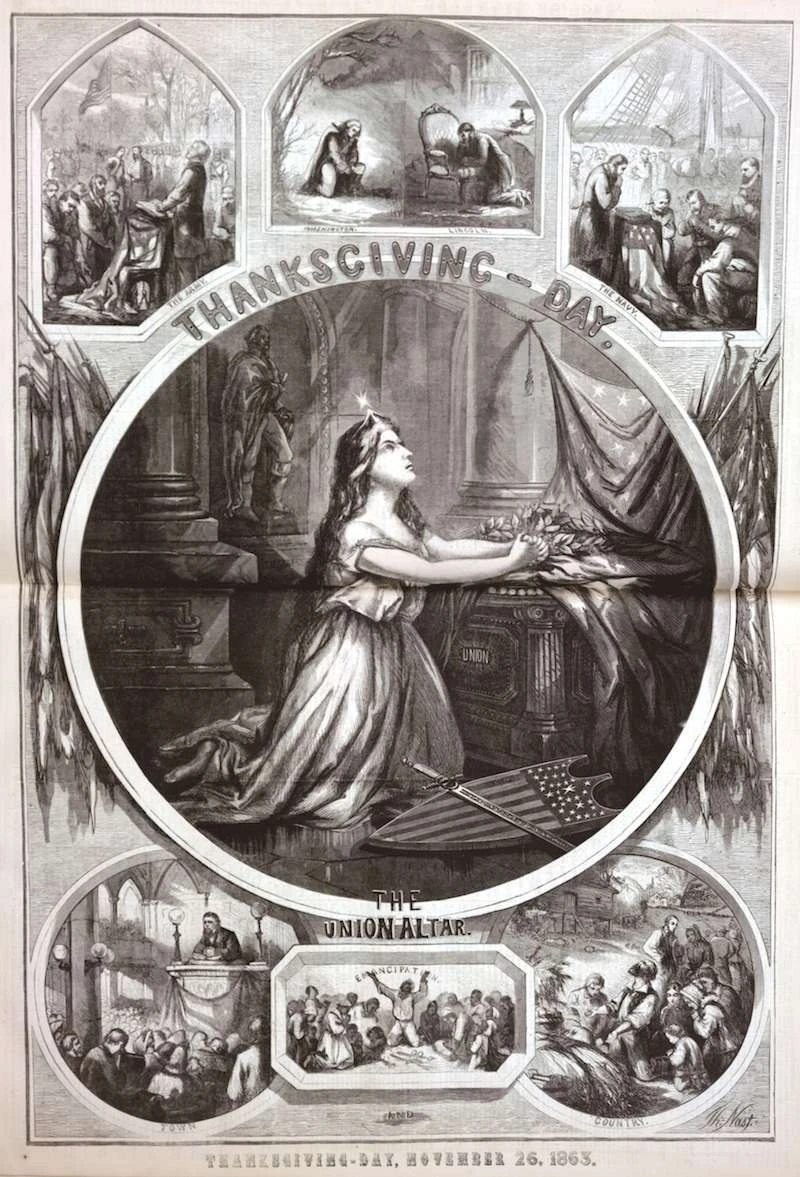
LOOK CLOSELY
The woman in the engraving represents the United States. She kneels at an altar bearing one word: UNION.
ONE MORE SURPRISE
The calendar still wasn’t settled.
Lincoln chose the last Thursday of November. Today the federal holiday falls on the fourth Thursday. Sometimes those are different days.
In 1939, Franklin Roosevelt moved Thanksgiving one week earlier to lengthen the Christmas shopping season. States split over the date. In 1941, Congress settled on the fourth Thursday.
November 1939
A month with five Thursdays
The fourth was the 23rd.
The last was the 30th.
BRING IT TO THE TABLE
How does an idea
become a tradition?
Hale did not invent Thanksgiving. Communities and governments had observed days of thanks long before her campaign; George Washington proclaimed one in 1789. Her contribution was helping turn a shared annual date into a lasting national custom.
This week, bring her story to your family or group: What tradition brings you together? And what would you keep working for, even if it took years?
Explore more We the People stories →