


USS Arizona Memorial · Pearl Harbor, Hawaiʻi
Can you see the ship?
The white building catches your eye first. Now look across it, from left to right. That long shadow under the water is the battleship USS Arizona.
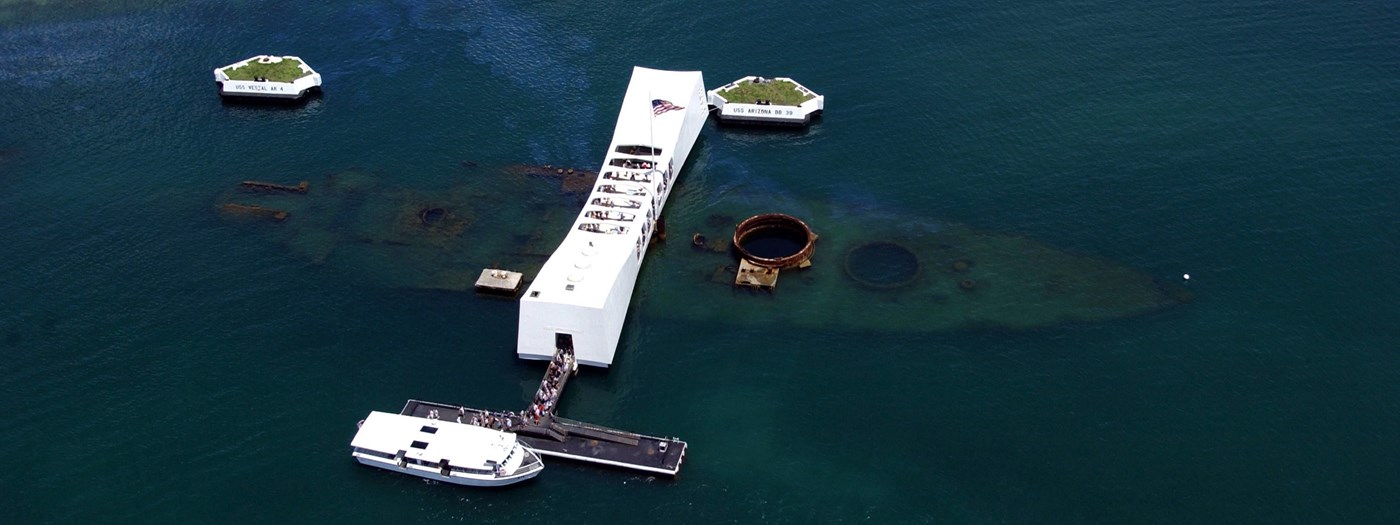
Look again at the far end of the white roof. There is an American flag there, small enough to miss. Its pole is fastened to what remains of the ship’s mainmast. Even now, the flag flies from the ship herself.
Sunday morning, December 7, 1941 · On the shore of Pearl Harbor
Jimmy went out to feed the pigs.
Eleven-year-old Jimmy Lee and his brothers had chores on their family’s farm less than a mile from Battleship Row, where the Navy tied up its battleships. When planes flew over, the boys sat down on the railroad tracks to watch.
“We thought it was like a show.”Jimmy Lee, recalling that morning for the National Park Service
Someone had to tell the children it was war. Just before eight that Sunday morning, aircraft from Japan’s navy had begun attacking U.S. ships and airfields on Oʻahu. Hawaiʻi was then a U.S. territory. Japan was expanding its war in Asia, and its leaders wanted to keep the American Pacific Fleet from interfering.
The Lees took shelter toward the mountains. When they came home, Jimmy went looking for his best friend, Toshi Yamamoto. They lived next door to each other and played together every day. Toshi’s house was empty. There was no note.
On Saturday, Jimmy and Toshi had played hide-and-seek and helped catch fish. They never saw each other again. Seventy-one years later, Jimmy told the story on the radio during a Pearl Harbor anniversary broadcast. Toshi’s son called. In a later conversation, he told Jimmy that his father had died and where he was buried.
Jimmy went to his friend’s grave to say goodbye.
What happened to Toshi’s family that morning?
In an oral history recorded by The National WWII Museum, Jimmy recalled that soldiers ordered the family to leave the shoreline. They had twenty minutes to gather what they could carry. Decades later, Jimmy took Toshi’s son and grandchildren back to the old house.
Sunday morning, December 7, 1941 · Aboard USS Arizona
Six men and a rope
That Sunday morning in 1941, Jimmy and his brothers watched the planes from the railroad tracks. Less than a mile away, six sailors aboard USS Arizona were waving to a man on the ship alongside them. His name was Joe George.

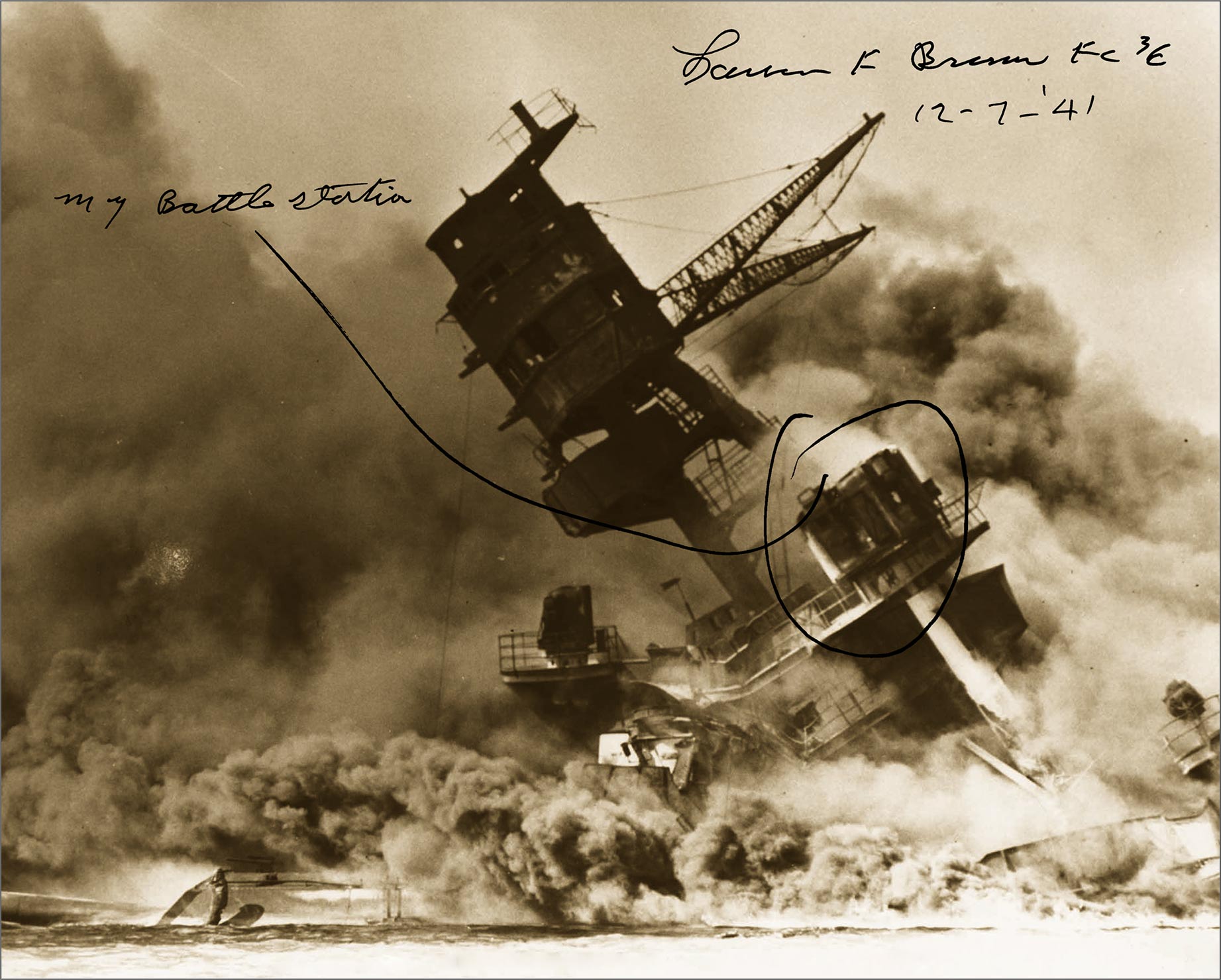
Fire had cut off the men’s way down. From the deck of the repair ship USS Vestal, George threw them a light line. They used it to pull a heavier rope across the gap. All six were badly burned. One by one, they made their way to Vestal, hand over hand. Bruner and Donald Stratton were among them.
Sunday, December 7 – Monday, December 8, 1941 · Washington, D.C.
One word in the margin
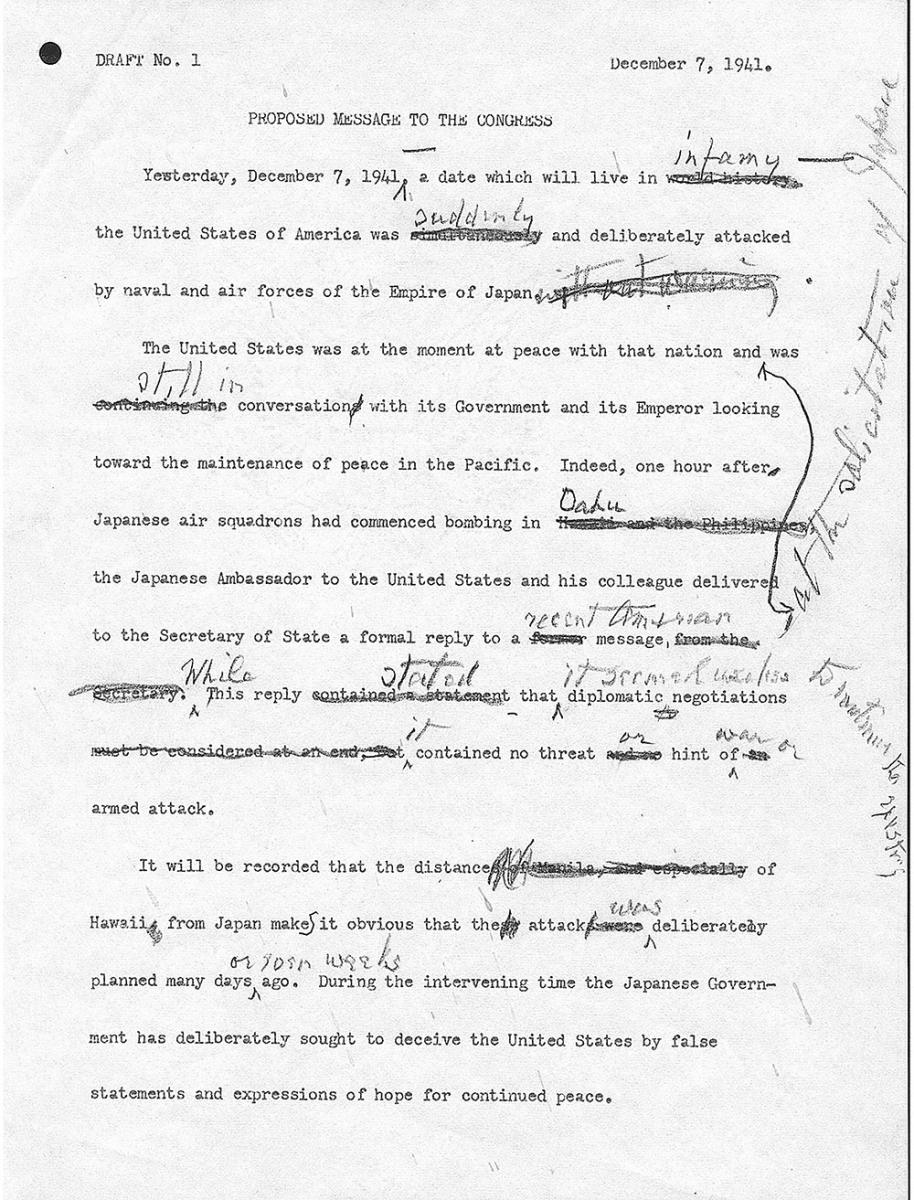
On Sunday afternoon in Washington, President Franklin Roosevelt dictated a short address to his secretary, Grace Tully. She typed it. He took a pen to the first sentence.
On the typed page
a date which will live in world history
Above the line
infamy
Try saying the opening both ways. “World history” tells us the day will be remembered. “Infamy” means lasting disgrace. That was the word Americans heard over the radio on Monday, December 8.
Roosevelt asked Congress to declare war on Japan. Congress voted that day, and he signed the declaration.
Look closer at Roosevelt’s handwriting
Find the two typed words under his pen stroke. Just above them, the tall first letter of “infamy” rises into the space between the lines.
Listen / Roosevelt addresses Congress
Hear the opening phrase as listeners heard it on December 8.
Transcript “Yesterday, December 7, 1941, a date which will live in infamy.”
Recording courtesy of the National Archives.
Thursday, December 7, 2017 · USS Arizona Memorial
The men who crossed
In 1962, a white memorial was dedicated above the sunken Arizona. Fifty-five years later, Donald Stratton and Lauren Bruner sat together there. In the photograph, Stratton is on the left. Bruner holds a coil of rope on the right. Look at their hands.
For years they had asked the Navy to recognize the man who had seen them waving. Joe George died in 1996. In 2017, his daughter accepted his Bronze Star for valor aboard the memorial. Stratton and Bruner were there.


July 1962 · Inside the USS Arizona Memorial
Now look up.
Return to the aerial photograph for a moment. You were looking down through the water at a ship. In this view from the year the memorial opened, the photographer stood inside and looked up. Between the white beams flies the flag of Arizona.
Architect Alfred Preis designed the memorial to dip in the middle and rise at both ends. At the far end, the crew members’ names fill a marble wall. The attack killed 2,403 American service members and civilians. On Arizona alone, 1,177 crew members died. More than 900 still rest with their ship.
December 7 is National Pearl Harbor Remembrance Day. Federal law asks the president to call on government agencies and interested organizations and individuals to fly the U.S. flag at half-staff. If someone asks you why the flag is lowered, you might start with the name of a ship. Or with two friends who used to play next door.